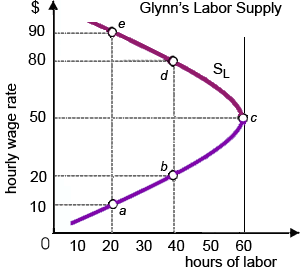
Highest hourly wages rate and lowest hours of labor
From the given choices, in given graph Glynn would be happiest at: (1) point a. (2) point b. (3) point c. (4) point d. (5) point e. Hello guys I want your advice. Please recommend some views for above Economics problems.
From the given choices, in given graph Glynn would be happiest at: (1) point a. (2) point b. (3) point c. (4) point d. (5) point e.
Hello guys I want your advice. Please recommend some views for above Economics problems.
I have a problem in economics on Bilateral Monopoly problem. Please help me in the following question. The bilateral monopoly is in operation when: (1) The firm is mere employer of some labor force and a union is the mere supplier of the labor for tha
The ceteris paribus (all as well constant) assumption is most obviously implicit in the statement of a tailor who states that, “We will vend more suits in the month of May of 2008: (i) Than we sold in the month of May 2003. (ii) Than we sold in
Can someone please help me in finding out the accurate answer from the following question. The changes in gasoline prices do not change short-run demands for (1) Bigger versus smaller cars. (2) Gasoline. (3) Alternative forms of the transportation. (4) Batteries, Tire
Can someone help me in finding out the right answer from the given options. The craft unions historically tried to systematize all the workers in: (1) A specific company, in spite of size. (2) The United States. (3) The specific broad industry. (4) Relatively highly s
I have a problem in economics on Existence of Diseconomies. Please help me in the following question. Diseconomies of the scale exist if: (1) Price reduces as more units are sold. (2) Total costs reduction as output raise. (3) Average costs raise as output rises. (4)
For a monopolist to raise the quantity of its products sold needs the monopolist to as: (i) raise the price of its product. (ii) charge a constant price. (iii) invest heavily in a distribution network. (iv) lower the price of its product. (v) advertis
A purely-competitive, short-run equilibrium does NOT need which each firm: (w) produces where MC = MR = P > min(AVC). (x) experiences no excess demand or excess supply. (y) earns only zero economic profit. (z) adjust output hence m
Can someone help me in finding out the right answer from the given options. Soybean farming is very much competitive, and United States is the major producer. The soybean mold carried on kangaroo rat fur devastates this year’s crop. This blight is eventually lea
I have a problem in economics on Equilibrium for a price maker firm. Please help me in the following question. In equilibrium, for a price maker firm, the charge of monopolistic exploitation is any difference among: (1) P and MR. (2) P and MC. (3) VMP
LoCalLoCarbo has become the favorite of fad dieters. There in given figure curve D shows: (1) LoCalLoCarbo’s marginal cost curve. (2) LoCalLoCarbo’s average variable cost curve. (3) LoCalLoCarbo’s average total cost curve. (4) the market demand curve
18,76,764
1958495 Asked
3,689
Active Tutors
1441325
Questions Answered
Start Excelling in your courses, Ask an Expert and get answers for your homework and assignments!!