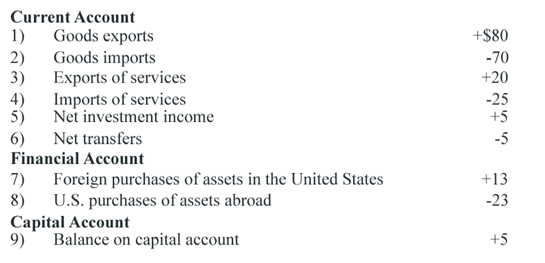
Goods and services
Refer to the above data. Choose the right answer from following. Zabella's balance on goods and services illustrates a: A) $5 billion deficit. B) $5 billion surplus. C) $10 billion surplus. D) $15 billion deficit.
Can someone please help me in finding out the accurate answer from the following question. The marginal resource cost for monopsonist in the labor market which can’t wage discriminate: (1) Is perfectly elastic. (2) Is perfectly inelastic. (3) Lies above the mark
Elucidate the Primary functions of money. Answer: Primary functions: 1) Medium of Exc
The yellow dog contracts are now proscribed, however in the early 20th century such agreements among employers: (i) Not to purchase intermediate goods made by unionized labor hindered labor market transformations. (ii) And workers stating that the workers would not jo
Can someone help me in finding out the precise answer from the given options. In the year 2005, the San Antonio Spurs basketball team increased all ticket prices and attendance surpassed the year 2004 attendance, pointing out a raise in the: (i) Upward slope of ticket
A profit maximizing monopolist produces output where: (i) MR = MC as long as the corresponding price exceeds average variable costs [P>AVC]. (ii) marginal revenue minus marginal costs [MR - MC] is maximized. (iii) price minus average cost is maximi
When the quantity of SCUBA lessons demanded by Hawaiian tourist’s increases from 800 to 1,000 weekly and if the price drops/falls from $30 to $20 per session, by using the arc elasticity formula, the price elasticity of demand will be: (i) 5.555
The increased pace of globalization and the steady development of worldwide demands for petroleum-based products from 2002 have tended to decrease the: (w) derived demand for petroleum. (x) prices of gasoline and electricity. (y) pressures which had reduced OPEC's eff
Select the right answer of the question. A restrictive monetary policy is designed to shift the: A) aggregate demand curve rightward. B) aggregate demand curve leftward. C) aggregate supply curve rightward. D) aggregate supply curve leftward
The American workers tend to be much productive than their counterparts in the South America or Asia in part as they have: (i) Superior natural genetic endowments. (ii) Access to the better sports programming, that promotes the team-work. (iii) More capital to work wi
I have a problem in economics on Problem regarding Privatization. Please help me in the following question. The procedure of transforming government-run production facilities into ‘for-profit’ businesses is: (i) Privatization. (ii) Cartelization. (iii) Cap
18,76,764
1956502 Asked
3,689
Active Tutors
1457205
Questions Answered
Start Excelling in your courses, Ask an Expert and get answers for your homework and assignments!!