--%>

Giving wholesale price per dozen by purely competitive firm

When Rose Garden Wholesalers has a typical type cost structure of rose farms within this purely competitive industry, into the long run new competitors would most likely enter the market providing the wholesale price per dozen roses exceeded as: (i) $3.00 per dozen roses. (ii) $3.83 per dozen roses. (iii) $4.00 per dozen roses. (iv) $4.30 per dozen roses. (v) $4.50 per dozen roses.
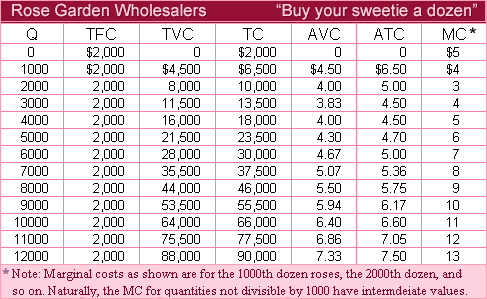
1181_Profits and Losses.png

Hey friends please give your opinion for the problem of Economics that is given above.

   Related Questions in Microeconomics

  • Q : Value of the marginal product of labor

    The Profit-maximizing firms which operate in the competitive resource and output markets adjust the labor inputs till the wage rate equivalents the: (i) Average revenue from the output. (ii) Output price equivalents the average variable cost. (iii) Marginal utility of

  • Q : Price elasticity of demand at high and

    Moving by left to right along demand curve D, then price elasticity of demand for cheesy fried grits of Pixie is mostly: (w) positive, then unitary, then negative. (x) constant and equivalent to one. (y) greater at high prices than at low prices. (z)

  • Q : Describe "in-market" mergers Describe

    Describe "in-market" mergers?An in-market merger is one which takes place among two banks operating in the similar geographic area, normally a city or metropolitan area. The merged institution frequently ends up with more than one branch in the

  • Q : Resources to escape state of destitution

    When an individual or family lacks adequate resources to escape a state of destitution, their circumstances are described as: (1) involuntary poverty. (2) relative poverty. (3) a vicious cycle of poverty (4) institutional poverty. (5) a culture of pov

  • Q : Jeremy Bentham utilitarianism Possible

    Possible utilization of a ‘felicific calculation’ to recognize punishments for the crimes was derived from: (1) Medieval scholasticism. (2) Say’s Law. (3) Gresham’s Law. (4) Marshall’s Maxim. (5) Jeremy Bentham&r

  • Q : Which of the following lists includes

    Which of the following lists includes only capital resources (and therefore no labor or land resources)?

  • Q : Monopsony and Marginal Resource Cost

    The labor monopsonist which doesn’t wage discriminates consists of a marginal resource cost curve [or marginal factor cost curve] which is above the labor supply curve then the firm faces as: (1) Monopsonists encompass market power in the markets for output. (2)

  • Q : Problem based on shift of the

    Technological advance in producing both capital goods and consumer goods is illustrated by the shift of the production possibilities curve from AB to: 1) CD. 2) EB. 3) AF. 4) GH.

    Q : Abolition of exploitation The removal

    The removal of exploitation of labor [that is, wage payments beneath the value to society of each and every individual worker’s productive contribution] is automatic when business decision makers: (v) Should set wages via collective bargaining agreements with th

  • Q : Labor-Leisure Tradeoffs features When

    When the real wage increases, an extra unit of: (1) Labor supplied will purchase fewer goods. (2) Leisure is more costly. (3) Output needs more labor time. (4) Capital becomes more highly employed. Find out the right answer from th