--%>

Formulating linear program of a Software company

A software company has a new product specifically designed for the lumber industry. The VP of marketing has been given a budget of $1,35,00to market the product over the quarter. She has decided that $35,000 of the budget will be spent promoting the product at the national trade show in New Orleans which will be held during this planning quarter.

Because eh product targets a specialized audience the VP has ruled out television radio and mainstream magazine advertisements. Instead she has decided to promote the product using black and white (B &W) and color ads in some or all of the followings specialized publications: Building today lumber weekly and timber world building today is a week day trade newspaper that accepts both full page and half page black and white advertising. Lumber weekly and timber world are glossy magazines that run both black and white and color ads. The VP and her staff have decided to run only full page ads in these last two publications. The circulation and advertising cost data for each outlet is summarized in the following table:
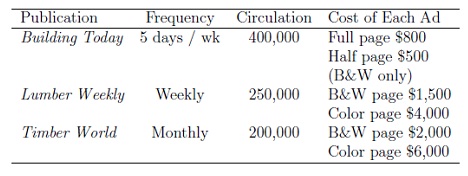
1758_softyarwe.jpg

After a discussion of the potential advertising the marketing team made the following judgment:

• A maximum of one ad should b placed in any one issue of any of the trade publications during the quarter:
• At least 50 full page ads should appear during the quarter:
• At least eight color ads should appear during the quarter:
• One ad should appear in each issue of timber world:
• At least four weeks of advertising should be placed in each of the building today and lumber weekly publications:
• No more than $40,000 should be spent on advertising in any one of the trade publications.

Formulate a linear programming model that will provide the VP and her marketing staff a marketing plan for the next quarter to maximize audience exposure for their new software product.

Implement your formulation in excel and find the optimal solution using solver. Sum marize your solution (decision variable values and objective function value ) below your formulation.

   Related Questions in Mathematics

  • Q : Test Please read the assignment

    Please read the assignment carefully and confirm only if you are 100% sure. Please go through below mentioned guidelines and penalties: • Your solution must be accurate and complete. • Please do not change Subject Title of the Email. • Penalty clause will be applied in case of delayed or plag

  • Q : First-order formulas over the

    Consider the unary relational symbols P and L, and the binary relational symbol On, where P(a) and I(a) encode that a is apoint and a (sraight) line in the 2-dimensional space, respectively, while On(a,b) encodes  that a is a point, b is a line, and o lies on b.

  • Q : Who developed a rigorous theory for

    Who developed a rigorous theory for Brownian motion?

  • Q : Competitive equilibrium 8. Halloween is

    8. Halloween is an old American tradition. Kids go out dressed in costume and neighbors give them candy when they come to the door. Spike and Cinderella are brother and sister. After a long night collecting candy, they sit down as examine what they have. Spike fi

  • Q : Abstract Algebra let a, b, c, d be

    let a, b, c, d be integers. Prove the following statements: (a) if a|b and b|c. (b) if a|b and ac|bd. (c) if d|a and d|b then d|(xa+yb) for any x, y EZ

  • Q : Problem on Fermats method A public key

    A public key for RSA is published as n = 17947 and a = 3. (i) Use Fermat’s method to factor n. (ii) Check that this defines a valid system and find the private key X.

    Q : Elasticity of Demand For the demand

    For the demand function D(p)=410-0.2p(^2), find the maximum revenue.

  • Q : How to get calculus homework done from

    How to get calculus homework done from tutor

  • Q : Who firstly use the finite-difference

    Who firstly use the finite-difference method?

  • Q : Explain Factorisation by trial division

    Factorisation by trial division: The essential idea of factorisation by trial division is straightforward. Let n be a positive integer. We know that n is either prime or has a prime divisor less than or equal to √n. Therefore, if we divide n in