--%>

Find unskilled labor for no minimum legal wage in market

When there is no minimum legal wage in market for unskilled labor, approximately: (w) 6,000 unskilled workers would earn about $5 per hour. (x) 3,000 unskilled workers would earn about $8 per hour. (y) 4,500 unskilled workers would earn regarding $6.50 per hour. (z) 6,000 unskilled workers would earn regarding $8 per hour.
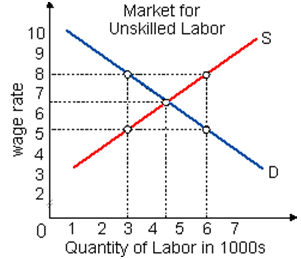
1420_Minimum Wage Laws.png

Can anybody suggest me the proper explanation for given problem regarding Economics generally?

   Related Questions in Microeconomics

  • Q : Changes in total revenue by price falls

    When the price falls along such demand curve for pizza, in that case total revenue: (w) falls. (x) rises, then falls. (y) rises. (z) does not change.

    Q : Lower market price to cover average

    When the market price is lower to cover average total costs, in that case a profit-maximizing firm will: (i) shut down instantly. (ii) continue to operate where P = MC when P > AVC. (iii) adopt newer technology. (i

  • Q : Quantity demanded to exceed quantity

    I have a problem in economics on Quantity demanded to exceed quantity supplied. Please help me in the following question. A shortage takes place whenever the current market price causes: (1) Quantity demanded to surpass quantity supplied. (2) Quantity

  • Q : Human Capital-Individuals premium wages

    The firm which offers its workers by substantial specific training tends to: (i) Pay such individuals premium wages to try to make sure retaining such workers. (ii) Need workers to sign the legal contracts of indenture and peonage. (iii) Raise worker productivity appr

  • Q : Prices and sales of normal goods The

    The growth of per capita national income would most likely rise the: (i) Prices of lard and employed tires. (ii) Federal budget deficit. (iii) Prices and sales of the luxury cars. (iv) Supply of untrained labor. Ca

  • Q : Quantity supply according to Law of

    Can someone please help me in finding out the accurate answer from the following question. The law of supply defines that at: (1) Higher prices greater quantities will be supplied. (2) Lower prices greater quantities will be supplied. (3) Lower prices supply shifts to

  • Q : Total costs of profit-maximizing lumber

    This profit-maximizing lumber mill incurs total costs of approximately: (a) $2200 per day. (b) $3300 per day. (c) $4200 per day. (d) $5200 per day (e) $6200 per day.

    Q : Profit-maximizing unregulated monopoly

    No profit-maximizing unregulated monopoly will function in the inelastic portion of the demand curve this faces since: (w) marginal revenue is negative. (x) total revenues are negative. (y) total revenue falls as less is produced. (z) marginal revenue

  • Q : Describe proportional in taxes as

    Line T1 depicts in given graph as in below a tax system which is: (i) progressive. (ii) recessive. (iii) proportional. (iv) biased. (v) regressive.

    Q : Present value of winnings by free

    You win the Idaho state lottery as well as are entitled to two tax-free payments of $500,000 every. You get the first payment today and the next payment in precisely one year. Suppose the interest rate is a generally high 25 percent.