--%>

Find linear demand curve by quantity and price graph

Along this illustrated linear demand curve, there is: (1) inelastic portion is range a. (2) elastic portion is range b. (3) midpoint is unitarily price elastic. (4) elasticity is constant in each and every ranges. (5) midpoint elasticity becomes infinite.
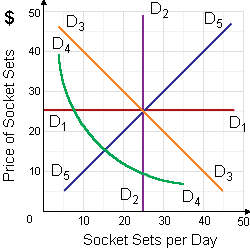
1993_Price Elasticity of Demand.png

Please choose the right answer from above...I want your suggestion for the same.

   Related Questions in Microeconomics

  • Q : Uses for break-even analysis Explain

    Explain what are the several uses for break-even analysis?

  • Q : Fixed constant cash flows in equal

    Financial instruments which promise fixed constant cash flows at equal time intervals forever are termed as: (1) coupon debentures. (2) perpetuities. (3) perennials. (4) residuals. (5) dividends. Please choose the righ

  • Q : Slopes of demand and supply curves The

    The slopes of demand and supply curves are frequently: (w) misleading as guides to price elasticities. (x) independent of the units measuring changes in price and quantity. (y) highly dependent upon each other. (z) used to forecast changing consumer t

  • Q : Arbitrage and Transaction Costs The

    The individual or organization which simultaneously purchases low and sells high in various markets is a/an: (i) Elevator. (ii) Speculator. (iii) Analyst. (iv) Arbitrageur. (v) Operator. Can someone please help me in finding out th

  • Q : Profit-maximizing to make economic

    This profit-maximizing brickyard of below illustrated figure on the average is, about: (i) making an economic profit of $8 per thousand bricks. (ii) incurring variable costs of $90 per thousand bricks. (iii) suffering an accounting loss of $2 per thou

  • Q : Marginal revenue curve A monopolist

    A monopolist which does not price discriminate has a marginal revenue curve which slopes down faster than does the demand curve the monopolist faces since: (1) economies of scale are significant. (2) selling more requires lowering the

  • Q : Deadweight Losses and Taxation Whenever

    Whenever a tax on a good outcome less government revenue than the sum of the losses of producer and consumer surpluses due to tax, economists state that the tax has caused a/an: (1) Administrative loss. (2) Market failure. (3) Economic loss. (4) Bureaucratic loss. (5)

  • Q : Price charging equality to marginal cost

    Within the short run, a price-maker firm along with important market power but that cannot price discriminate is unable to concurrently maximize profit and: (i) charge a price equal to marginal cost. (ii) minimize average total cost. (iii) produce out

  • Q : Price discriminate for maximizing profit

    Monsieur Cournot has a monopoly on an artesian well from that flows tasty spring water reputed to have medicinal properties. To ignore incurring variable costs, he is adamants that customers bring their own pails and also fill them in

  • Q : Determine price elasticity coefficient

    In below this demonstrated figure, there demand curve: (w) D0D0 is perfectly price-inelastic. (x) DD is perfectly price-elastic. (y) DD has a price elasticity coefficient of unity (1). (z) D0D0 has a price e