--%>

Farm maximizes profit of producing at wholesale price

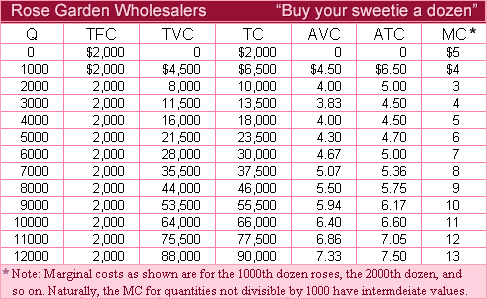
When the wholesale price P = $3 per dozen increased, this purely competitive increased farm maximizes profit with producing ___ dozen increased at a total (loss or profit) of $___. (i) zero; loss; $2000. (ii) 2000; loss; $1500. (iii) 3000; profit; $1500. (iv) 4000; profit; $4,500. (v) 4000; profit;$2,000.
1382_Profits and Losses.png

Can someone explain/help me with best solution about problem of Economics...

   Related Questions in Microeconomics

  • Q : Equilibrium outputs in long-run entry

    Long-run supply curve of a purely competitive industry: (w) equals the horizontal summation of all firms’ short-run supply curves. (x) reflects equilibrium outputs after entry and exit respond completely to any shifts in demand. (y) declines as

  • Q : Relative utility-Consumer Equilibrium

    Can someone please help me in finding out the accurate answer from the following question. The relative utility from the last dollar used up on food is the ratio: (i) Marginal utility of food or production cost of food. (ii) The Price of food or net grocery bill. (iii

  • Q : Difference between increase in demand

    Difference between increase in demand and increase in quantity: Whenever demand rises at specific price then it is termed as rise in demand?. On another hand, whenever demand increases by decrease in price of a com

  • Q : Zero or negative marginal utility of a

    Whenever the marginal utility of a good becomes negative or zero: (i) Goods are transformed to the bads. (ii) Net utility reaches the maximum and then declines. (iii) The maximum total advantages have been squeezed from good. (iv) People are unwilling

  • Q : Laws and Regulations-Seller of the good

    The Caveat venditor is an ancient legal doctrine which, when the products are defective or fraudulently symbolized, imposes legal liabilities on: (1) Seller of the good. (2) Government, for failing to save consumers. (3) Resource owner. (4) Buyer, for failing to use d

  • Q : Bond of fixed annual income A bond

    A bond which pays a fixed annual income always is: (w) an eternity. (x) a perpetuity. (y) worthless. (z) infinitely valuable. Can anybody suggest me the proper explanation for given problem regarding Econom

  • Q : High poverty rate among not employed

    The high poverty rate in between those who do not work: (w) reflects voluntary choices for leisure over income and work. (x) is no cause for concern if it involves voluntary choice. (y) occurs since family responsibilities prevent many people from wor

  • Q : Percentage changes in quantity supplied

    The price elasticity of supply can be very approximately computed as the percentage change within: (w) responsiveness of price to variations within the quantity supplied. (x) quantity divided through the intercept coefficient of the supply curve. (y)

  • Q : Monopsonistic labor market-wage

    In the monopsonistic labor market in which wage discrimination is not possible, the raise in the minimum wage: (i) Essentially outcomes in less employment and higher wages. (ii) Might result in both the higher level of employment and the higher wage rate. (iii) Unifor

  • Q : Strategic Barriers to Entry The

    The successful employment of expensive marketing techniques through established competitors in an oligopoly: (w) encourages entry by other profit maximizing firms. (x) raises the minimum efficient scale of production for new entrants. (y) acts as a re