--%>

Explain Java PathFinder

Java PathFinder: Java PathFinder (JPF) is a model checker that has been developed as a verification and testing environment for Java programs (Figure shown below). It is available as open source at SourceForge.net (JPF website). It consists of a custom-made Java Virtual Machine (JVM) that interprets bytecode, combined with a search interface to allow the complete behavior of a Java program (including all interleavings of concurrent programs) to be analyzed. JPF itself is implemented in Java and its architecture is highly modular and extensible to support rapid prototyping of new features. JPF works at the bytecode level, and therefore it can uncover errors at both source and bytecode levels.
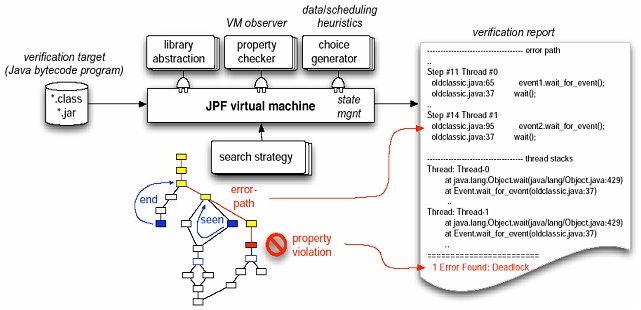
1777_java pathfinder.jpg

   Related Questions in Programming Languages

  • Q : Define Deprecated Deprecated : Somewhat

    Deprecated: Somewhat that has been made superseded by later on versions of the API. Deprecated methods must not be employed as there is no guarantee that they will carry on to subsist in the future versions.

  • Q : Define Statement Statement : The

    Statement: The fundamental building block of Java method. There are numerous different kinds of statement in Java, for example, the assignment statement, if statement, while loop and return statement.

  • Q : What do you mean by java AWT What do

    What do you mean by the term java AWT? Describe in brief.

  • Q : What is Bit Bit : It is a binary digit

    Bit: It is a binary digit that can take on two possible values: 0 and 1. The bits are basic building block of both data and programs. Computers regularly shift data around in multiples of eight-bit units (that is, bytes for the sake of effectiveness).

  • Q : Define the term Internet Define the

    Define the term Internet: It is a global network of numerous interconnected networks.

  • Q : Define Accessor method Accessor method

    Accessor method: A technique specifically designed to offer access to a private attribute of a class. By convention, we name accessors with a get prefix followed by the name of the attribute being accessed. For example, the accessor for an attribute n

  • Q : What is an Exception Exception : An

    Exception: An object symbolizing the occurrence of an exceptional circumstance - usually, something which has gone wrong in the smooth running of a program. Exception objects are made from classes which expand the Throwable class.

  • Q : Define Protocol Protocol : It is a set

    Protocol: It is a set of rules for interaction between two processes. The protocol is generally specified in a Uniform Resource Locator (abbreviated as URL) to point out how a specific resource must be transferred from a Web server to the requesting c

  • Q : Define the term Binary Binary : This is

    Binary: This is the number representation in base 2. In base 2, only digits 0 and 1 are utilized. Digit positions symbolize successive powers of 2.

  • Q : Explain Try statement Try statement :

    Try statement: The try statement performs as an exception handler - a position where exception objects are caught and dealt with. In its most common form, it comprises of a try clause, one or more catch clauses and the finally clause.