--%>

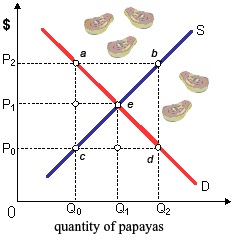
Excess of good in market problem

The excess of papayas would appear when: (1) seller’s supply prices increase to P1. (2) Govt. set a price ceiling of P1. (3) Growers predicted prices to soar. (4) Hurricane destroyed all Central American papaya plantations. (5) Government obliged a price floor of P2.
2082_10.jpg

Please someone suggest me the right answer.

   Related Questions in Microeconomics

  • Q : Technological advances in natural

    Natural barriers to entry may be overcome across time from: (w) cut-throat competition. (x) elimination of patent laws. (y) technological advances. (z) rigorous enforcement of antitrust laws. How can I solve my

  • Q : Ratio to determine income elasticity of

    The income elasticity of demand [at a specified price] is computed by the ratio of the relative: (a) change in quantity demanded over a given proportional change in income. (b) reciprocal of the price elasticity of supply. (c) slope of the demand curv

  • Q : Question on lowering the supply The

    The Reagan Administration introduced new agricultural program named as the Payment-in-Kind Program, in the year of 1983. In order to distinguish how the program worked, let's assume the wheat market. Now assume the government desire to lower the supply of whe

  • Q : Explain about the minimum legal price

    Please help me to solve the problem that is given below. A minimum legal price is a price: (1) foundation. (2) umbrella. (3) ceiling. (4) cut.  (5) floor. I need a good ans

  • Q : Illustration of monopolistic competition

    A small neighbourhood grocer in a big town mainly close approximates a: (i) pure competitor. (ii) monopolist. (iii) monopolistic competitor. (iv) oligopolist. (v) monogamist. Hello guys I want your advice. Please recommend some vie

  • Q : Total costs of profit-maximizing lumber

    This profit-maximizing lumber mill incurs total costs of approximately: (a) $2200 per day. (b) $3300 per day. (c) $4200 per day. (d) $5200 per day (e) $6200 per day.

    Q : Maximizing profit by hiring labor The

    The firm maximizes profit by hiring the labor at a point where labor’s: (i) Marginal physical product equal its average physical product. (ii) Marginal revenue product equivalents its marginal resource cost. (iii) Rate of exploitation is maximum. (iv) Wage rate

  • Q : Operate market by economies of scale

    When a firm experiences economies of scale which span the bulk of demand in the market, in that case the market which this operates within will tend to: (i) evolve into a monopoly. (ii) become inefficient before this gets extremely large. (iii) seldom

  • Q : Purely competitive market at

    For a purely competitive market at any equilibrium point on the short-run supply curve: (w) all firms have identical marginal costs. (x) economic profit is positive. (y) accounting profit is normal. (z) marginal revenue = average cost.

    Q : Problem on spending shares of national

    The view which big corporations unfailingly capture much stable shares of spending out of national income is: (i) Accepted by almost all the economists. (ii) Contrary to the confirmation of turnover among big over the decades. (iii) The symptom of strong competition.