--%>

Example to illustrate non-tariff trade barriers

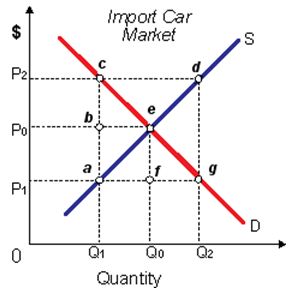
Imports and American cars are close nevertheless not ideal substitutes. When the U.S. government tried to boost American car sales through setting a price ceiling of P1 upon imported cars in that case: (w) the quantity of cars imported will fall from Q0 to Q1. (x) American car prices would rise to P2. (y) foreign car exporters would ship more luxury cars to the United States. (z) American-made car sales would rise by Q2 to Q0.
427_Trade Barriers.png

Hello guys I want your advice. Please recommend some views for above economics problems.

   Related Questions in Microeconomics

  • Q : Severe Poverty of Demography From the

    From the 1950 year, severe poverty has declined most sharply in between people while they experience: (w) low levels of education. (x) discrimination in employment. (y) old age. (z) poor health. Can someone explain

  • Q : Labor Force Participation Rates The

    The percentage of a specified population who are either unemployed or employed is termed as the: (1) labor force participation rate. (2) work-force proportion. (3) labor supply. (4) substitution effect dominance rate. (5) income-leisure loss curve.

    Q : Process of Capitalization

    Capitalization is a process: (a) that converts fixed cost into variable cost. (b) by which predictable income flows are translated into wealth. (c) of financial intermediation by bankers. (d) of exploiting unskilled workers.

    Q : Productivity related problem Other

    Other things equal, an improvement in productivity will: A) shift the aggregate demand curve to the left. B) shift the aggregate supply curve to the left. C) shift the aggregate supply curve to the right. D) increase the price level.

  • Q : Powerful firm confronted by powerful

    The model which examines the limits to bargaining among a powerful firm confronted by the powerful union is: (1) Bilateral monopoly model. (2) Pure monopsony model. (3) Convergence model. (4) Featherbedding model. (5) Keynesian cross model.

    Q : Perpetuities with fixed amount of money

    A security which promises to pay a fixed amount of money annually till the issuer purchases this from an owner is termed as a: (i) present value. (ii) future value. (iii) perpetuity. (iv) residual. (v) trust fund.

  • Q : Rates of Return of Cash Flow Assume

    Assume that an apartment complex is predicted to produce a consistent net $800,000 cash flow yearly in rent, after deducting all recurring variable costs (for example, taxes, utilities, and maintenance). When its current price is $10

  • Q : Price equality to marginal costs A

    A nondiscriminating monopolist's equilibrium output is inconsistent along with: (w) marginal revenue equals marginal cost [MR = MC]. (x) price equal to marginal costs [P = MC]. (y) price exceeding average variable costs [P > AVC]. (z) price exceedi

  • Q : Monopsonistic labor market-wage

    In the monopsonistic labor market in which wage discrimination is not possible, the raise in the minimum wage: (i) Essentially outcomes in less employment and higher wages. (ii) Might result in both the higher level of employment and the higher wage rate. (iii) Unifor

  • Q : Destitute Percentage of Income The

    The percentage of American families that stay put destitute year after year is around: (w) 1 2%. (x) 3 5%. (y) 5 7%. (z) 8 10%. Hello guys I want your advice. Please recommend some views for above Economics problem