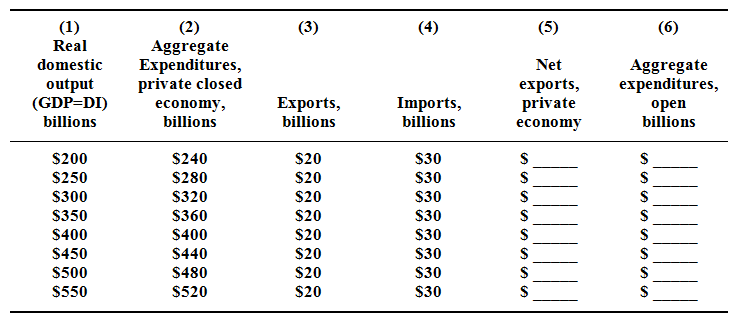
Equilibrium GDP for this hypothetical economy
The data of columns 1 and 2 of the below table are for a private closed economy. Employ columns 1 and 2 to find out the equilibrium GDP for this hypothetical economy.
Expert
Equilibrium GDP for closed economy will be $400 billion.
Briefly describe the terms proprietorship, partnership, and corporation.A proprietorship is a business owned by one person. Two or more people who join together to develop a business make up a partnership. It can be done on an inf
Organization Code: The four-digit code allotted to each state governmental entity (and at times to exclusive budgetary programs) for fiscal system aims. The organization code is the initial segment of the budget item or appropriation
Normal 0 false false
3-year Expenditures and Positions: The display at the beginning of each departmental budget which presents the different departmental programs by title, dollar totals, places, and source of funds for the past, current, and budget years.
Financial Restructuring: It is the reorganizing of a business' liabilities and assets. The procedure is frequently related with corporate restructuring where an organization's on the whole structure and its processes are refurbished. Though companies
Appropriation Schedule: The detail of an appropriation (example, in the Budget Act), exhibiting the distribution of the appropriation to each of the class, programs, or projects thereof.
What influence has mergers and acquisitions had on a customer's access to branches?A branch closing that has resulted from a merger require not necessarily mean a lost relationship. The cause a branch closes is usually the presence of a nearby b
Schedule of Operating Expenses and Equipment, Supplementary: The supplemental schedule proposed by department’s throughout budget preparation that details by object the expenses comprised in the Operating Expenses and Equipment class.
18,76,764
1948578 Asked
3,689
Active Tutors
1437057
Questions Answered
Start Excelling in your courses, Ask an Expert and get answers for your homework and assignments!!