--%>

Equal distributions of income or wealth

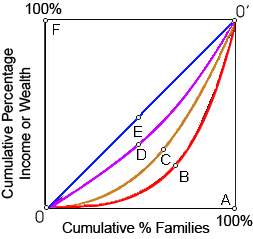
Perfectly equal distributions of income or wealth are reflected within the Lorenz curve demonstrated as: (i) line 0A0'. (ii) line 0B0'. (iii) line 0C0'. (iv) line 0D0'. (v) line 0E0'.
1104_Problem on Lorenz Curve1.png

Hello guys I want your advice. Please recommend some views for above Economics problems.

   Related Questions in Microeconomics

  • Q : Implicit Costs definition The Implicit

    The Implicit costs are: (i) The opportunity costs of resources contributed by the firm’s owner. (ii) Costs that need a cash outlay. (iii) Usually comprised in the computation of accounting profit. (iv) Fictional costs which do not influence the

  • Q : Supply in short-run equilibrium When a

    When a purely competitive industry is within short-run equilibrium, this: (w) should also be in long-run equilibrium. (x) won’t be in long-run equilibrium. (y) may or may not be within long-run equilibrium. (z) will experience m

  • Q : Problem regarding Bilateral Monopoly

    The Bilateral monopoly models would be most suitably employed to analyze the negotiations among: (1) Le-Bron James, an all-star NBA basketball player and the Cleveland Cavaliers. (2) A newly hired clerk at Wal-Mart and the Wal-Mart Human Resources Dep

  • Q : Determine price elasticity of perfectly

    A city government trying to pass an excise tax for that the economic burden would be borne strictly through the seller will succeed when this imposes a tax on a good for that the price elasticity of: (i) demand is unitarily elastic. (

  • Q : Kinked Demand by decreasing price In

    In this kinked demand curve model as in given graph, when this firm operated at point a and lowered its price by P2 to P1 and other firms in the industry also lower prices, in that case this firm will move from point a to: (w) po

  • Q : Total sales revenues and price

    If the price falls, there total sales revenues rise, in that case the price elasticity of demand: (1) relatively elastic. (2) relatively inelastic. (3) unitary elastic. (4) zero elastic. (5) inflexibly marginal.

    Q : Needs by marginal revenue equals to

    A monopolist produces where marginal revenue [MR] equals marginal costs [MC] when it needs to maximize: (i) total revenue. (ii) consumer surplus. (iii) profits. (iv) total revenue, producer surplus and profits. (v) job security.

  • Q : Higher value for the Gini index A

    A higher value for Gini index tends to be related with: (w) decreases in the equality of the distribution of income or wealth. (x) decreases in the population’s total amount of income or wealth  (y) reduced overall curvature of the Lorenz c

  • Q : Trends in Poverty Into the United

    Into the United States during 2000 and 2005, the: (w) number of families below the poverty line declined. (x) distribution of after-tax income became significantly more equal. (y) percentage of families below the poverty line grew. (z) share of wealth possessed by the

  • Q : Relationship between APP-MPP If APP is

    If APP is at its maximum, then what is the relationship among MPP and APP? Answer: MPP = APP