--%>

Elasticity of the supply possible quantity of labor

When Chandra and Morgan are identically skilled and every can decide the number of hours she works as: (w) the elasticity of Morgan’s labor supply exceeds the elasticity of supply for Chandra’s labor at each possible quantity of labor. (x) Morgan’s income exceeds Chandra’s while their wage rates are less than $12 per hour. (y) Chandra’s income exceeds Morgan’s if their wage rates exceed $15 per hour. (z) Chandra and Morgan will have identical incomes at a wage rate of $18 per hour.
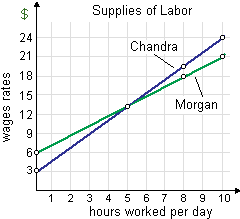
173_Labor Leisure Tradeoffs.png

Hello guys I want your advice. Please recommend some views for above Economics problems.

   Related Questions in Managerial Economics

  • Q : States the term Shift in Demand States

    States the term Shift in Demand?

  • Q : Concept of derived demand The concept

    The concept of derived demand means that: (w) consumer demands for goods depend on the utilities received from their use. (x) firms’ demands for resources depend upon consumer demands for the goods produced. (y) governmental demands for social g

  • Q : Illustrates definition and meaning of

    Illustrates the definition and meaning of managerial economics?

  • Q : Dependency of labor supplies Labor

    Labor supplies depend on wage rates and also: (w) labor force participation and capital availability. (x) worker skills and preferences regarding employment. (y) technology and the price of output. (z) labor force participation and derived demand.

  • Q : Substantial general training to certain

    When a firm gives substantial general training to specific workers: (i) it is probable to pay them a premium wage to cut labor turnover. (ii) the workers are likely to receive less pay than their VMPs after such training. (iii) the workers are most pr

  • Q : Smoothing techniques or Exponential

    Explain about the term smoothing techniques.

  • Q : Labor Supply Curves to Competitive Firms

    A price taker within the labor market: (w) can set the wage that this will pay for the labor this hires. (x) can set the wage at which this will supply the use of its labor. (y) doesn’t care what wage this pays or receives. (z) can’t influ

  • Q : States the term fixed cost in briefly

    States the term fixed cost in briefly.

  • Q : Costs of investing within human capital

    The costs of investing within human capital are probably to be borne by the employee when human capital a worker obtains “on the job” is: (1) general. (2) marginal. (3) precise. (4) generic. (5) specific.

    Q : Lower Wages in Wage Differentials

    Compared to men along with similar amounts of education or experience, women onto average earn: (1) higher wages. (2) similar wages. (3) lower wages. (4) There is no general pattern. Can someone explain/help me with best solution a