--%>

Elasticity of supply of labor by changing in wage rate

If the wage rate increases from $10 per hour to $25 per hour, then the elasticity of the supply of labor from this worker is roughly: (1) zero. (2) 7/15. (3) one. (4) minus 8/15.
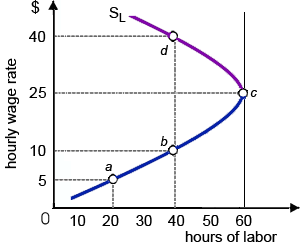
349_Problem on Supply of Labor.png

Hey friends please give your opinion for the problem of Economics that is given above.

   Related Questions in Managerial Economics

  • Q : What are the types of elasticity of

    What are the types of elasticity of demand?

  • Q : Illustrates the pricing policy and

    Illustrates the pricing policy and practices?

  • Q : Opportunity cost of good Since an

    Since an economy moves downward all along the production possibility frontier which is concave from beneath, the: (1) Opportunity cost of the good whose production goes increasing. (2) Law of rising returns outcomes ever lower costs. (3) Dollar value

  • Q : Forecasting demand what are the

    what are the criteria for good forecasting

  • Q : Most elastic to least elastic ranking

    For most kinds of labor, the most accurate ranking of labor supplies through most elastic to least elastic is most likely: (1) firm, small industry, occupation. (2) economy, individual, occupation. (3) firm, economy, occupation. (4) individual worker,

  • Q : Less elastic demand for labor The

    The demand for labor is less elastic when: (w) resource substitution is easy. (x) output demand is relatively inelastic. (y) wages are a huge percentage of total cost. (z) firms have more time to adjust to wage changes.

    Q : Illustrates the real concept briefly

    Illustrates the real concept briefly?

  • Q : Cost concept of business operation and

    Categories the cost concept of business operation and decision making?

  • Q : Diminishing Returns and Increasing Costs

    I have a problem in economics on Diminishing Returns and Increasing Costs. Please help me in the following question. The concave (or bowed out) production possibilities frontier means that the opportunity costs are: (i) Constant (ii) Increasing (iii)

  • Q : Wage Differentials by Adam Smith Adam

    Adam Smith would have had the greatest complexity in describing income differentials as depends on scarcity and productivity for the case wherein: (1) Holly lives into New York City and is paid more than Devin, who has a same job in K