--%>

Effect on total revenue by raises price

A price raise from $6 to $8 would effect in: (1) a decrease in total revenue. (2) an increase in total revenue. (3) no change in total revenue. (4) consumers buying more pizza. (5) pizza parlors selling more pizza.
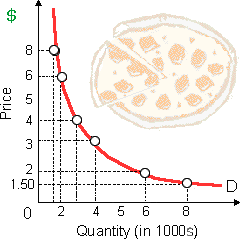
1167_pizza budgets graph.png

Please choose the right answer from above...I want your suggestion for the same.

   Related Questions in Microeconomics

  • Q : Needs by marginal revenue equals to

    A monopolist produces where marginal revenue [MR] equals marginal costs [MC] when it needs to maximize: (i) total revenue. (ii) consumer surplus. (iii) profits. (iv) total revenue, producer surplus and profits. (v) job security.

  • Q : Problem regarding Subjective Prices

    Mike trades 6 vintage baseball cards for the Jake’s original Ty Cobb card. When Mike’s six cards had equivalent total market value with Jake’s Ty Cobb card, then this trade would show: (i) Unfair incentive. (ii) Demand price. (iii) Opportunity cost.

  • Q : Pure competition or monopoly with

    Compared along with pure competition or monopoly, not perfect competition is: (w) far more common in Europe than in the United States. (x) much more common in markets during the world. (y) much less common in advanced nations than in underdeveloped na

  • Q : Profit for purely competitive firms in

    Profit for purely competitive firms tends in the direction of zero in the long run since: (w) managers resist charging more than a fair price. (x) firms collude to charge prices which barely cover average costs. (y) profit attracts entry, whereas loss

  • Q : Accounting profit when implicit cost

    Can someone please help me in finding out the accurate answer from the following question. When implicit cost surpasses implicit revenue and economic profit is zero (0), then accounting profit is: (1) Bigger than zero. (2) Zero. (3) Less than 0 (zero). (4) Not specifi

  • Q : Help The problem of asymmetric

    The problem of asymmetric information is that: a) neither health care buyers nor providers are well-informed. b) health care providers are well-informed, but buyers are not. c) the outcomes of many complex medical procedures cannot be predicted. d) insurance companies are well-informed

  • Q : Changes in supply of loanable funds The

    The supply of loanable funds changes positively along with the: (w) willingness of people to defer consumption in the future. (x) profitability and productivity of new capital investments. (y) price of the output about new capital will produce. (z) fu

  • Q : Increasing economic profits in a

    Rising economic profits within a competitive market do NOT produce pressures for: (i) expansions of existing firms. (ii) entry by new firms. (iii) price hikes. (iv) increases in costs for specialized resources. (v) ultimate erosion of

  • Q : Tax on a good tends to make The tax on

    The tax on a good tends to make: (i) Inflationary pressure the govt. can disperse by cutting its spending. (ii) The wedge among prices buyers pay and the prices sellers obtain. (iii) Rises in supply from the viewpoint of buyers. (iv) More quick transa

  • Q : Inferior good from income elasticity of

    When income elasticity of market demand is minus 1 (one), the good is: (w) average good. (x) intermediate good. (y) inferior good. (z) "image" good. How can I solve my economics problem? Please suggest me the corre