--%>

Economic Rent of Demand Curve

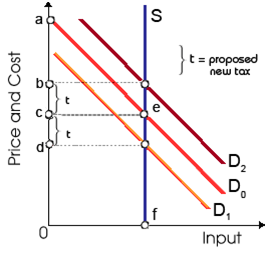
When D0 is the initial demand curve for land in this illustrated figure, within equilibrium the economic rent realized through the landowner will be: (1) zero. (2) area Ocef. (3) area cae. (4) area Oaef. (5) a pure economic profit.
377_Economic Rent Problems.png

Please guys help to solve this problem of Economics with some explanation.

   Related Questions in Microeconomics

  • Q : Freedom to enter or leave the market in

    Purely competitive industries are not described by: (i) numerous potential buyers. (ii) product homogeneity. (iii) numerous potential sellers. (iv) freedom to enter or leave the market within the short run. (v) power to adjust quantities although no p

  • Q : Kinked Demand by decreasing price In

    In this kinked demand curve model as in given graph, when this firm operated at point a and lowered its price by P2 to P1 and other firms in the industry also lower prices, in that case this firm will move from point a to: (w) po

  • Q : Quantity supply or demand to changes in

    When a measure of the responsiveness of one variable to other (for example, quantity supplied [or demanded] to changes within price), elasticity: (w) provides no criterion for identifying responsiveness. (x) depends on the units used to express change

  • Q : Analytic Time-Technological Long Run

    The chronological time needed for the technology to respond to modifications in profit opportunities (that is, the technological long run, also termed as super long run or temporal long run) is: (1) Longer than analytical long run for firm. (2) Shorter than market per

  • Q : Purely competitive seller in demand

    The demand curve facing a purely competitive seller is: (a) negatively sloped. (b) horizontal at the market price. (c) vertical at the market quantity. (d) the horizontal summation of all potential buyers’ individual demand curves. (e) market de

  • Q : Constant cost industries In

    In constant-cost, the purely competitive industries: (w) total cost is constant at every output. (x) marginal cost is constant at each output. (y) number of firms is constant at every output. (z) long-run supply price is uninfluenced by output. <

  • Q : Problem on Decisions at the Marginal

    The least clear illustration of how decisions are generally at the margin would be: (i) A floral shop hiring an additional clerk and opening earlier in hopes of increasing revenues by half. (ii) Eating less whenever the menu is a-la-carte than at an ‘all-you-can

  • Q : Limitation of marginal revenue Marginal

    Marginal revenue is NOT: (i) similar as average revenue or price for a competitive firm. (ii) identical to the price of output for firms along with monopoly power. (iii) specified by (change in TR)/ (change into Q) for all firms. (iv) derived by the d

  • Q : Effect of Increase in per capita income

    Rises in per capita income in the United States would be most probable to reduce the: (i) Demands for lard, pinto beans, and utilized tires. (ii) Excesses in the federal govt. budget. (iii) Supply of untrained labor relative to skilled labor. (iv) Tot

  • Q : Reduces total production cost and raise

    Assume that Joe discovers the price elasticity of market demand to be 0.8 for Joe’s additional fancy dehydrated water at the present price of $10 per barrel. Every barrel averages $2 to generate. Joe can: (w) increase his profits by 80% if he in