--%>

Economic profits maximizing

When this monopolistic competitor produces Q units, this is maximizing: (w) sales development and its market share. (x) total revenue. (y) economic profits. (z) total fixed cost and its managers' salaries.
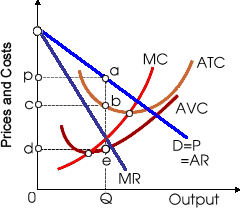
2019_Monopolistic Competition.png

Can anybody suggest me the proper explanation for given problem regarding Economics generally?

   Related Questions in Microeconomics

  • Q : Assumption of economic model-financial

    Most of the economic models suppose that the financial goal of a corporation is the maximization of the value of: (1) Firm’s net revenue. (2) Accounting gains to the firm. (3) Firm to its shareholders. (4) Progress of the sales revenues. (5) Monetary advantages

  • Q : Increase total revenue by increasing

    A monopolist can raise total revenue by increasing output when: (w) demand is elastic. (x) demand is inelastic. (y) demand is unitarily elastic. (z) supply is perfectly elastic. Can someone explain

  • Q : Cross price elasticities of demand The

    The cross price elasticities of demand are possibly most positive for: (w) shoe repairs and new shoes. (x) syrup and waffles. (y) gasoline and limousines. (z) college tuitions and textbooks. How can I solve my

  • Q : Change in prices after short run demands

    Can someone please help me in finding out the accurate answer from the following question. The changes in gasoline prices do not change short-run demands for (1) Bigger versus smaller cars. (2) Gasoline. (3) Alternative forms of the transportation. (4) Batteries, Tire

  • Q : Pay annual income by perpetuities bonds

    When all bonds are perpetuities which pay annual income of $50, at an interest rate of 5% the price of bonds is: (w) $1,000. (x) $500. (y) $100. (z) $750. Can someone explain/help

  • Q : Price charging by minimizing average

    See a monopolist which cannot price discriminate but that maximizes profit. When this firm produces the level of output where is average cost at its minimum that will charge a price: (i) equal to marginal cost and generate zero economic profit. (ii) e

  • Q : Result of successful product

    One complicated result of successful product differentiation: (1) the demand curve shrinks making this more elastic. (2) the demand curve becomes perfectly elastic. (3) prices do not vary considerably between close substitutes. (4) each marginal reven

  • Q : Wage differentials-union and nonunion

    I have a problem in economics on Wage differentials-union and nonunion workers. Please help me in the following question. The wage differentials among union and nonunion workers encompass historically averaged roughly: (i) 10% to 15 %. (ii) 5% to 10%.

  • Q : Demand in a specific period In adding

    In adding up to price, the quantity of a good bought throughout a given period is recognized by: (1) Income. (2) Tastes and preferences. (3) Numbers of buyers in market. (4) Prices of associated goods. (e) All of above. Can someone

  • Q : Income elasticity of demand The income

    The income elasticity of demand for mass transit of 0.6 signifies that the demand for mass transit: (1) Is a requirement. (2) Is a luxury. (3) Will increase at a slower rate than income. (4) Will drop/fall when personal incomes increases average.