--%>

Easily enter or exit the market in the long run

This graph depicts a short run situation while long run equilibrium has been achieved for a firm along with some market (price-making) power when the firm cannot price discriminate and: (w) has explicit costs but no implicit costs. (x) operates in an industry in that competitors can easily enter or exit the market in the long run. (y) is closely regulated by government to ensure which this does not price discriminate. (z) maintains a constant level of market power because of substantial barriers to entry within the market.
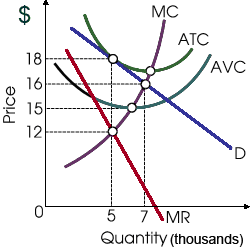
840_Monopolistic Competition1.png

I need a good answer on the topic of Economics problems. Please give me your suggestion for the same by using above options.

   Related Questions in Microeconomics

  • Q : Market supply and demand information

    Elucidate what kind of market supply and demand information would be use full to you in deciding on a business policy?

  • Q : Substitution effect of income at wage

    Glynn’s preferences in between work and leisure give in a: (i) wealth effect that exceeds the leisure consequence above point c. (ii) weak preference for working more than 40 hours per week. (iii) substitution effect that exceeds the income effect at wage rates

  • Q : Break-even on profit-maximizing strategy

    Robomatic Corporation would exactly break-even upon its RoboMaids when, instead of exactly identifying its profit-maximizing strategy, this: (i) operated at point i, charging only $10,000 per unit and producing 16,000 robots. (ii) pri

  • Q : Bilateral Monopoly problem I have a

    I have a problem in economics on Bilateral Monopoly problem. Please help me in the following question. The bilateral monopoly is in operation when: (1) The firm is mere employer of some labor force and a union is the mere supplier of the labor for tha

  • Q : Resolving principal-agent problems I

    I have a problem in economics on Resolving principal-agent problems. Please help me in the following question. Attempts to resolve the principal-agent problems among stockholders and top corporate managers (that is, CEOs) comprise: (i) Profit-sharing systems for the t

  • Q : Characteristics of purely competitive

    Characteristics of purely competitive markets do not comprise: (w) homogeneous products. (x) large numbers of potential buyers. (y) large numbers of potential sellers. (z) the capability of sellers to set prices. I

  • Q : Example of predatory behavior Assume

    Assume that a new Wal-Mart is built just outside a small town, and also Wal-Mart aggressively cuts prices therefore much that the rivals close their doors. In that case, once its rivals exit the market, the Wal-Mart raises prices significantly. Wal-Ma

  • Q : Advantage of Law of Equal Marginal in

    Assume that the last week your food budget yielded 5 utils from your previous $4 burrito; and 4 utils from your previous $5 hot fudge sundae. Purchasing one: (i) More burrito and one less sundae this week would reduce total utility. (ii) More sundaes and one less burr

  • Q : Prospective financial investment by

    Assets turn into less desirable to prospective financial investors while: (w) they become more liquid. (x) interest rates increase. (y) their prices go up. (z) default risks decrease. How can I solve my Eco

  • Q : Profit Maximization-Labor Markets

    When after hiring the very last worker, the organization’s profit is similar as it was prior to the last worker was hired, the firm must: (1) Hire more workers to raise the profit. (2) Layoff several workers to raise gain. (3) Not hire any more workers. (4) Shut