--%>

Earning price in Human capital

As per shown in this graph, the average high school graduate will earn around: (1) $12,000 yearly. (2) $20,000 yearly. (3) $45,000 yearly. (4) $90,000 yearly. (5) $100,000 yearly.
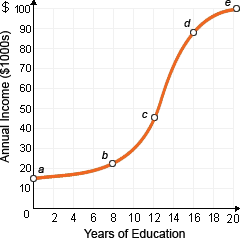
1528_Human Capital problem.png

How can I solve my Economics problem? Please suggest me the correct answer.

   Related Questions in Managerial Economics

  • Q : Illustrates the responsibilities of

    Illustrates the responsibilities of managerial economists?

  • Q : Limitations of Marginal Costing Write

    Write down the limitations of Marginal Costing?

  • Q : Examples of Economic Capital

    Landscaping a garbage dump along with topsoil, grass and trees to construct a golf course is an illustration of creating new: (i) capital. (ii) land. (iii) employment. (iv) economic profits. (v) natural resources. Please guys help

  • Q : Introduction of the term P-V ratio Give

    Give a brief introduction of the term P/V ratio and Contribution?

  • Q : Illustrates the term variable cost

    Illustrates the term variable cost?

  • Q : Values of marginal products of the

    Competitive product as well as resource markets yields resource prices and incomes to resource owners that are proportional to the: (1) relative prices of the goods produced. (2) values of marginal products of the resources. (3) distr

  • Q : Determine the demand of auto-market

    Suppose that the auto market began at the intersection of S0 and D0 before people began to expect auto prices to rise in the close to future. How will it influence the auto market?: (1) No change. (2) Demand shifts to D2. (3) Demand sh

  • Q : Elasticity of the supply possible

    When Chandra and Morgan are identically skilled and every can decide the number of hours she works as: (w) the elasticity of Morgan’s labor supply exceeds the elasticity of supply for Chandra’s labor at each possible quantity of labor. (x) Morgan’s i

  • Q : Operational or internal issues of

    What are the operational or internal issues of managerial economics?

  • Q : Opportunity costs of purely financial

    By a purely financial perspective, you must stop going to school while you: (w) graduate from college. (x) have to take out educational loans at interest rates which exceed the inflation rate. (y) face opportunity costs of education exceeding the expe