--%>

Earning income within negative income tax

Under the negative income tax system demonstrated in this figure, a family of four along with no earned income would have a net as after-tax, the income of: (1) $15,000 per year. (2) $10,000 per year. (3) $5,000 per year. (4) $2,500 per year. (5) $0 per year.
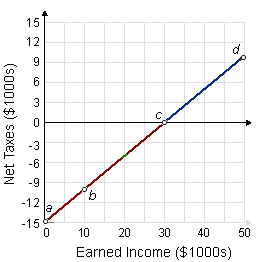
2070_Negative Income Tax Problem.png

I need a good answer on the topic of Economics problems. Please give me your suggestion for the same by using above options.

   Related Questions in Microeconomics

  • Q : Define Producers equilibrium Producers

    Producers equilibrium signifies the stage beneath which with the help of given factors of production producer attain the level of production of which he is acquiring maximum gain.

  • Q : Problem on Substitute Goods declining

    The market demand curve for the potatoes would shift to the left in reaction to: (1) New research pointing that eating French fries helps prevent cancer. (2) Potato lovers becoming alarmed regarding the rumored potato shortage. (3) Genetic engineering methods that mak

  • Q : Constant cost industry of production

    When Del’s production function and costs are characteristic for wheat farmers and when wheat farming is a constant cost industry, in that case in the long run, there the price of wheat will be: (i) $4 per bushel. (ii) $6 per bushel. (iii) $8 per

  • Q : Consumer Surplus-Difference in amounts

    Kiley pays $1.00 for the cold Pepsi on a hot afternoon, however would be willing to pay $5.00. The $4.00 difference in such amounts is her: (i) Consumer surplus. (ii) Income effect. (iii) Economic gain. (iv) Marginal utility. (v) Pleasure coefficient.

    Q : Differentiate project feasibility study

    Differentiate between project feasibility study and project proposal?

  • Q : Problem regarding Rational Ignorance

    Whenever decision makers select not to pursue further information as the expected reward for the searching for it does not surpass its expected cost, the outcome is: (1) Adverse choice. (2) Consumer exploitation. (3) Unintended effects. (4) Asymmetric information. (5)

  • Q : Infinite price elasticity of supply The

    The price elasticity of supply in given grph is infinite therefore supply is perfectly price elastic within: (w) Panel A. (x) Panel B. (y) Panel C. (z) Panel D.

    Q : Emphasis on equality of opportunity An

    An emphasis on equality of opportunity, although not essentially equality of result, is a center-piece of a system of distribution termed as: (1) meritocracy. (2) laissez faire capitalism. (3) feudalism. (4) socialism. (5) syndicalism

  • Q : Price equality with marginal costs It

    It is not possible for a nondiscriminating, that profit maximizing monopolist to attain equilibrium where MR = MC as well as: (w) economic profit = 0. (x) economic profit is negative. (yz marginal costs are at the minimum of average costs [MC = ATC].

  • Q : Demand and supply influences

    Changes in both demand and supply of a commodity might or might not influence its equilibrium price. Describe.