--%>

Earning income under negative income tax

Under the negative income tax system demonstrated in this figure, a family of four along with earned income of $15,000 yearly would have a net [after-tax] income of: (i) $30,000 per year. (ii) $27,500 per year. (iii) $25,000 per year. (iv) $22,500 per year. (v) $20,000 per year.
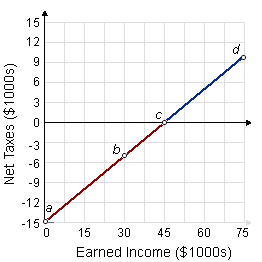
1815_Problem on Negative Income Tax.png

Can someone explain/help me with best solution about problem of Economics...

   Related Questions in Microeconomics

  • Q : Differentiate Income and Wealth One

    One main difference between income and wealth is which: (w) wealth is inherited, income is earned. (x) income generates wealth, wealth cannot generate income. (y) all income is subject to taxation, most wealth is not. (z) wealth is a stock variable, i

  • Q : Negatively sloped demand curve for

    The idea which harsher and more certain punishment decreases cheating on examinations recommends that: (i) Normative values must guide the positive economics. (ii) Student honesty has refused in recent years. (iii) Macroeconomic reasoning as well applies to microecono

  • Q : International demand or supply affected

    Sixty Chinese manufacturers have started producing generic staplers. Since each factory is very small to noticeably influence the international demand or supply for staplers, every firm is: (1) a cartelized seller. (2) a price taker. (3) a primary goo

  • Q : Levels of the Poverty Line In 2005

    In 2005 year, the proportion of people along with family incomes below the official poverty line into the United States was around: (w) one in eight. (x) one in ten. (y) two in twenty five. (z) one in twenty.

    Q : Excess supply at the minimum price

    Programs which guarantee farmers minimum prices which exceed equilibrium prices will yield: (w) cheaper food for consumers. (x) excess demand in food markets. (y) excess supply at the minimum price. (z) higher equilibrium prices.

  • Q : Operate market by economies of scale

    When a firm experiences economies of scale which span the bulk of demand in the market, in that case the market which this operates within will tend to: (i) evolve into a monopoly. (ii) become inefficient before this gets extremely large. (iii) seldom

  • Q : Rational Investments and Sunk Costs

    Decisions are most obviously less than perfectly rational while: (1) you take a shortcut through a dark alley at 3:00 am to get home faster. (2) a brilliant student majors into art history in place of economics. (3) prisoners on death row in Texas know that tobacco ca

  • Q : Economies of Scope-Firms using

    Firms which use similar production facility or groups of inputs to concurrently generate various kinds of products are taking benefit of: (1) Tax loop-holes. (2) Variegated production. (3) Economies of scope. (4) Economies of scale. (5) Monopoly power.

    Q : Price elasticity when total revenue

    Total revenue grows while the price of a good is cut when the price elasticity of: (w) demand exceeds the price elasticity of supply. (x) substitute goods is less than one. (y) supply is into a relatively elastic range. (z) demand is

  • Q : Government programs influencing

    Government programs assuring farmers minimum legal price floors which surpass equilibrium market prices will outcome: (1) Cheaper food for consumers. (2) Scarcities of food and the potential for famine. (3) Surplus demand in food markets. (4) Maximum equilibrium price