--%>

Domestic production possibilities curve

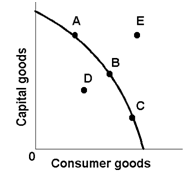
Refer to the following domestic production possibilities curve for Karalex. The gain to Karalex from specialization and international trade is represented by a move from: 1) A to B. 2) C to A. 3) C to D. 4) B to E.
814_hj.png

Help me to get through this problem

   Related Questions in Microeconomics

  • Q : Rates of Return on Investment The

    The income stream per period like a percentage of the dollar outlay for investment into a capital good is the: (1) present value of the investment good. (2) rate of economic profit. (3) interest rate. (4) rate of retu

  • Q : Securing financing by selling stock Can

    Can someone please help me in finding out the precise answer from the following question. One of the reasons that some new corporations secure much financing by selling the stock is that: (1) Financial investors form higher rates of return from the bond interest than

  • Q : Describe "in-market" mergers Describe

    Describe "in-market" mergers?An in-market merger is one which takes place among two banks operating in the similar geographic area, normally a city or metropolitan area. The merged institution frequently ends up with more than one branch in the

  • Q : Positively-sloped supply curve

    A straight-line, which positively-sloped supply curve which starts from the quantity axis is: (w) elastic for all prices and quantities. (x) inelastic for all prices and quantities. (y) unitarily elastic for all prices and quantities. (z) a sign that

  • Q : Price elasticity of demand as

    As the Shmoo Recording Studio raised CD production from 3 million units to 5 million units, this was forced to discount CD prices down by $18 to $15. Then price elasticity of demand for Shmoo CDs is as: (w) 0.022. (x) 0.36. (y) 1.0. (z) 2.75.

  • Q : Concentration ratio Explain the concept

    Explain the concept of a concentration ratio.  Is the concentration ratio in a monopolistically competitive industry likely to be higher than for a perfectly competitive industry

  • Q : Competitive equilibrium in competitive

    I have a problem in economics on Competitive equilibrium in competitive labor markets. Please help me in the following question. The Competitive equilibrium in competitive labor markets need: (1) P = MR = AVC. (2) VMP - P is maximized. (3) MPP = P. (4

  • Q : Individual Welfare Recipients If an

    If an individual receives benefits from the government, associate to the benefits everyone else receives, which exceed the individual’s taxes like a proportion of total tax payments by all citizens, which individual can reasonably be viewed like

  • Q : Responding higher prices for heating

    Can someone help me in finding out the right answer from the given options. Canadians would ultimately be likely to respond to higher prices for heating oil and natural gas through (i) Turning up their electric blankets and insulating their houses more carefully. (ii)

  • Q : Prohibition in Economic Profit Economic

    Economic profits are not: (1) a surplus of revenues over opportunity costs. (2) quite similar to pure economic rents from society’s viewpoint. (3) zero in a purely competitive economy along with no uncertainty and zero transaction costs. (4) dif