--%>

Differences in the arc elasticities of demands

The dissimilarities in the arc elasticities of demands for labor among the Ajax Corporation and Bosun Limited are consistent along with an inference which Bosun: (1) is a more profitable firm than Ajax. (2) hires more highly skilled workers than Ajax does. (3) will grow quicker than the Ajax Corporation. (4) can most likely substitute capital for labor more productively than Ajax can. (5) produces output which sells for a higher price than Ajax’s product.
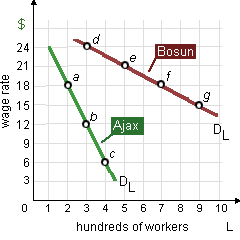
1045_Elasticity of the Demand for Labor.png

Can anybody suggest me the proper explanation for given problem regarding Economics generally?

   Related Questions in Microeconomics

  • Q : Arc elasticity formula for price

    When raising subscription rates to the News and Observer from $8 to $10 monthly cause newspaper sales to drop by 180,000 to 120,000 copies daily, using the arc elasticity formula, then price elasticity of demand equals to: (1) 0.9. (2

  • Q : Monopolistic Exploitation problem Can

    Can someone help me in finding out the right answer from the given options. When a firm hires labor to a point where VMPL > MRPL = MFCL = w, then the (1) Firm consists of monopsony power. (2) Employees of firm are experiencing t

  • Q : Relation of transaction costs with

    Transaction costs are costs mainly related with the: (w) transportation and gathering information about goods or resources. (x) direct production costs for goods. (y) inputs quite than outputs. (z) supply prices rather than demand prices.

  • Q : Generates price-quantity consistent for

    All prospective demanders [buyers] would be within equilibrium when this market for teleporter buttons created a price and a quantity consistent along with: (1) eliminating the shortage Q1-Q3 existing at P3<

  • Q : Wage of firm elasticity of demand for

    A firm’s wage elasticity of demand for labor is least influenced by: (1) how much time the firm has to adjust to changing wages. (2) the proportion of labor’s share of the total costs.  (3) the ease of substitution in between capital

  • Q : Free Trade Agreement Tell me the answer

    Tell me the answer of this question. Critics of the North American Free Trade Agreement (NAFTA) falsely feared that it would: A) increase the flow of illegal Mexican immigrants to the United States. B) cause the European Union and Japan to raise trade barriers against

  • Q : Product Differentiation During product

    During product differentiation, the firms attempt to: (w) become price takers. (x) gain a degree of market power over their pricing and sales of their products. (y) increase the supply of their products. (z) raise the price elasticity of the demand fo

  • Q : Open Shop-union membership Firms which

    Firms which employ workers devoid of needing any form of either union membership or dues are the: (i) Agency shops. (ii) Laissez-faire shops. (iii) Union shops. (iv) Closed shops. (v) Open shops. Can someone please help me in findi

  • Q : Traditional transfer in kind assistance

    Most traditional transfer in kind helps programs: (w) increased benefits for every dollar earned. (x) reduced benefits by $1 for every dollar earned. (y) reduced benefits by less than $1 for each dollar earned. (z) reduced benefits by more than $1 for

  • Q : Definition of Collective Bargaining The

    The procedure in which employers and unions agree to labor contracts which govern work arrangements is termed as: (i) Arbitration. (ii) Codependency. (iii) Bilateral monopoly. (iv) Joint profit maximization. (v) Collective bargaining.

    Discover Q & A

    Leading Solution Library
    Avail More Than 1419713 Solved problems, classrooms assignments, textbook's solutions, for quick Downloads
    No hassle, Instant Access
    Start Discovering

    18,76,764

    1953692
    Asked

    3,689

    Active Tutors

    1419713

    Questions
    Answered

    Start Excelling in your courses, Ask an Expert and get answers for your homework and assignments!!

    Submit Assignment

    ©TutorsGlobe All rights reserved 2022-2023.