--%>

Determine unskilled labor for minimum wage laws in market

A minimum legal wage of $5 per hour in this market for unskilled labor would: (w) have no effect on employment or the wages paid. (x) create new jobs for 3,000 unskilled workers. (y) move some low-skilled workers above the poverty line. (z) create unemployment for 3,000 unskilled workers.
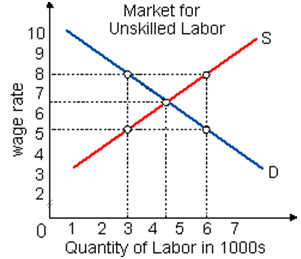
1349_Minimum Wage Laws.png

I need a good answer on the topic of Economic problems. Please give me your suggestion for the same by using above options.

   Related Questions in Microeconomics

  • Q : Demand and supply problem Assume that

    Assume that the demand for jeans rises. At similar time, since of an increase in price of cotton, the supply of jeans reduces. How will it influence the price and amount sold of jeans?

    Q : Wage Differentials-occupational crowding

    The Disadvantaged groups have historically been pressured in the direction of low wage jobs in a process termed as: (i) Occupational crowding. (ii) Labor staggering. (iii) Systemic discrimination. (iv) Reverse favoritism. (v) Nepotism.

    Q : Meaning of tax Meaning of tax : Tax is

    Meaning of tax: Tax is a legally compulsory payment imposed on the people by the government. There are two kinds of taxes: Direct taxes and Indirect taxes.

  • Q : Price elasticities for market demand

    Of the given price elasticities [ed] for market demand curves, there the one which is absolutely implausible by the vantage of standard economic theory would be one for that, across all conceivable ranges of prices: (1) ed= 0 and the

  • Q : Profit-maximizing lumber on the average

    On the average, that profit-maximizing lumber mill as in demonstrated graph is: (w) making an economic profit of regarding $0.20 (20¢) per 2×4. (x) incurring variable costs of $0.90 (90¢) per 2×4. (y) suffering an accounting loss

  • Q : Analytic Time-The Market Immediate The

    The analytical period of time is very short that the firm could not adjust output by hiring more or less of a variable resource was recognized by Alfred Marshall as: (1) Immediate or market period. (2) Long run. (3) Short run. (4) Technological or temporal long run.

  • Q : Marginal revenue product and marginal

    When a monopolist maximizes the profit in a product market, it will: (i) Hire labor till the marginal revenue product equivalents marginal resource cost. (ii) Hire labor till the value of marginal product equivalents marginal resource cost. (iii) Pay a wage equivalent

  • Q : Efficiency Wages problem The employees

    The employees at times pose principal-agent problems for the firm’s owners in the deficiency of constant monitoring. Such problems are most probable to be lessened when a firm adopts the policy of: (1) dynamically opposing the attempts to unionize. (2) Paying em

  • Q : Monopsonistic exploitation-labor union

    The labor union contracts, a comparable worth rule, or minimum salary laws might boost up equilibrium employment when a firm has been practicing: (i) Price discrimination. (ii) Monopolistic exploitation. (iii) Feather-bedding. (iv) Blacklisting. (v) Monopsonistic expl

  • Q : Short-run equilibrium of

    A purely-competitive, short-run equilibrium does NOT need which each firm: (w) produces where MC = MR = P > min(AVC). (x) experiences no excess demand or excess supply. (y) earns only zero economic profit. (z) adjust output hence m