--%>

Determine unitarily elastic demand of price

Assume that many students have fixed “pizza budgets.” When the price per slice falls by $10 to $1 along such demand curve for pizza weekly near a college campus, then the price elasticity of demand for pizza: (w) rises towards infinity. (x) falls towards zero. (y) rises, then falls. (z) always equals 1 and demand is unitarily elastic.
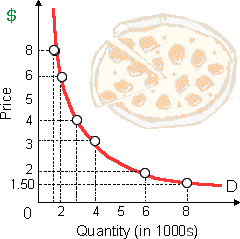
1826_pizza budgets graph.png

Hello guys I want your advice. Please recommend some views for above economics problems.

   Related Questions in Microeconomics

  • Q : Quantity demanded grows with price cut

    A price elasticity of demand coefficient of 2.5 approximately implies that: (1) quantity demanded rises 1 percent while price rises 2.5 percent. (2) quantity demanded grows 2.5 percent along with a 1 percent price cut. (3) price rises 2.5 percent whil

  • Q : Perfectly Competitive market condition

    In which market condition, the effect of an individual seller is (0) zero? Answer: In Perfectly Competitive market condition.

  • Q : Output and price comparison with

    Compared to the output and price which are allocatively efficient by the vantage point of society, in that case a monopolist tends to: (w) produce less and charge a higher price. (x) maximize average profits when possible. (y) set price in the inelast

  • Q : Economic profits by potential customers

    When you lease a building for five years and rapidly achieve economic profits since it is located conveniently for potential customers: (1) you could capitalize some of these pure profits when you sold your business along with a sublease at the ending

  • Q : Determine present value by interest rate

    When the annual interest rate is 12 percent and a rental house can be expected to rent perpetually for price of $1,000 monthly, in that case the house has a present value of approximately: (1) $240,000. (2) $144,000. (3) $100,000. (4) $72,000. (5) $12

  • Q : Marginal cost curve in market power

    Above the minimum average variable cost curve, the marginal cost curve is not the supply curve of a monopoly since, unlike purely competitive firms, firms along with market power: (w)

  • Q : Boosting minimum wage laws Boosting

    Boosting minimum wage laws from $5 to $8 per hour is LEAST probable to: (w) give some unskilled workers with higher incomes. (x) cause some low-wage workers to lose their jobs. (y) raise friendship like a basis for employment. (z) decrease unemploymen

  • Q : Purely-competitive output by profit

    Profit is maximized when this purely-competitive brickyard constructs at: (i) point a. (ii) point b. (iii) point c. (iv) point d. (v) point e.

    Q : Labor Productivity The American workers

    The American workers tend to be much productive than their counterparts in the South America or Asia in part as they have: (i) Superior natural genetic endowments. (ii) Access to the better sports programming, that promotes the team-work. (iii) More capital to work wi

  • Q : Quantity supply or demand to changes in

    When a measure of the responsiveness of one variable to other (for example, quantity supplied [or demanded] to changes within price), elasticity: (w) provides no criterion for identifying responsiveness. (x) depends on the units used to express change