--%>

Determine total revenue when maximizes economic profits

Total revenue when this firm maximizes economic profits would be: (w) $72,000 per period. (x) $80,000 per period. (y) $96,000 per period. (z) $100,000 per period.
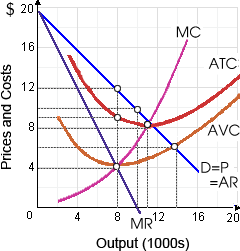
392_Price Discrimination.png

Can anybody suggest me the proper explanation for given problem regarding Economics generally?

   Related Questions in Microeconomics

  • Q : Explaination of balance of payment

    explaination of balance of payment identity

  • Q : AFC curve What does AFC curve appear

    What does AFC curve appear like? Why does it appear so?

  • Q : Powerful firm confronted by powerful

    The model which examines the limits to bargaining among a powerful firm confronted by the powerful union is: (1) Bilateral monopoly model. (2) Pure monopsony model. (3) Convergence model. (4) Featherbedding model. (5) Keynesian cross model.

    Q : Inflation premium Describe the term

    Describe the term Inflation premium and how it is the prospect of future inflation?

  • Q : Determine competitive price of purely

    In this demonstrated figure purely competitive lumber mill’s generic 2×4s now sell for: (1) $3.60 each. (2) $3.00 each. (3) $2.70 each. (4) $2.40 each. (5) $2.10 each.

    Q : Problem on price elasticity and total

    A) Use the table below to draw graphs that show the relationship between price elasticity of demand and total revenue. <

  • Q : Price and quantity supply The

    The positively sloped supply curves exhibit relationships which: (1) Follow from law of demand. (2) Are positive between quantity supplied and price. (3) Are negative between price and the quantity sold. (4) Exist for services however not goods.

  • Q : CAPM and Portfolio The information is

    The information is illustrated below: (a) Determine the expected return on Stock X?

  • Q : Profit maximized by nondiscriminating

    A nondiscriminating unregulated monopolist maximizes profit by: (w) charging the highest price the market will bear. (x) often changing designs and building in planned obsolescence. (y) setting marginal costs equal to marginal revenue [MC = MR]. (z) s

  • Q : Reducing proportion of the work force

    The assertion which unions are more powerful nowadays than ever before is: (i) Supported by the consequences of the union contracts on an inflationary spirals. (ii) Reflected in the growing proportion of workers included in violent, protracted and costly strikes. (iii