--%>

Determine total cost of profit-maximizing competitive firm

This profit-maximizing competitive firm's total cost as TC=TFC+TVC, as in demonstrated figure can be calculated as area: (i) 0P3fq4. (ii) P2P1de. (iii) P3P2ef. (iv) 0P2eq4. (v) aced.
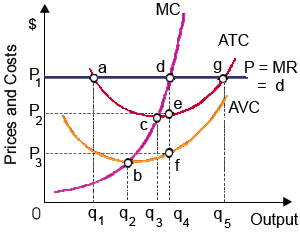
1406_Total Revenue1.png

Hello guys I want your advice. Please recommend some views for above Economics problems.

   Related Questions in Microeconomics

  • Q : Economic profits in long run A monopoly

    A monopoly will make economic profits within the short run: (w) but cannot create economic profits in the long run. (x) if average total costs [ATC] > P. (y) as long as total revenue exceeds total costs. (z) All of the above.

  • Q : Persistent range of output by economies

    When economies of scale are persistent across the range of output which people might feasibly purchase, in that case: (w) pure competition is the most efficient market structure. (x) competition will prevent monopolization of the industry. (y) competi

  • Q : Similarity between pure monopoly and

    The demand curve facing a pure monopoly is similar to the: (w) sum of demand curves which face pure competitors. (x) "kinked" demands at the going market price. (y) the market demand curve for its product. (z) the firm's marginal reve

  • Q : Surviving for maximum profits in

    Supposing that the competitive firms should seek the maximum profits to survive signifies that: (1) Firm do not make trial-and-error decisions. (2) Each and every firm always seeks the maximum gain and nothing else. (3) Competition is very profitable.

  • Q : Problem regarding to present value and

    When the price of a financial asset is of $2,000 and the interest rate is 10 percent, in that case investment is not reasonable for: (1) a perpetuity paying $200 annually. (2) an income stream paying $1000, $800, and $600, respectivel

  • Q : Estimate profit-maximizing price The

    The profit-maximizing price for RoboMaids is: (1) $24,000 per robot. (2) $20,000 per robot. (3) $16,000 per robot. (4) $12,000 per robot. (5) $10,000 per robot.

    Q : Total revenue when a price increases

    For hamburgers the demand is relatively elastic. When the price of hamburgers increases, in that case: (i) the quantity demanded will go up. (ii) its demand will increase. (iii) total revenue will increase. (iv) total revenue will reduce.

  • Q : Explain about price-taker The purely

    The purely competitive firm: (w) is a price-taker. (x) confronts an inelastic demand curve. (y) should decide what price to charge. (z) maximizes total revenue. How can I solve my Economics problem

  • Q : Market structure of monopoly A monopoly

    A monopoly is a type of market structure in that one: (w) seller produces whole industry’s output. (x) giant firm is a price taker. (y) barrier to entry exists. (z) giant firm is the single buyer of resources.

    Q : Managerial Economics-Error of omission

    Can someone please help me in finding out the precise answer from the following question. The ‘error of omission’ takes place when: (1) Managers pursue policies which outcome in layoffs. (2) Corporations vend more stock than is really available. (3) Manage