--%>

Determine the yearly total revenues with price and quantity

When the U.S. wheat market as in below demonstrated graph is primarily within equilibrium on S0D0, in that case the yearly total revenues (price × quantity) of wheat farmers will equivalent: (1) 0P4gQ4. (2) 0P3eQ3. (3) 0P2dQ2. (4) 0P1bQ1. (5) 0P3aQ1.
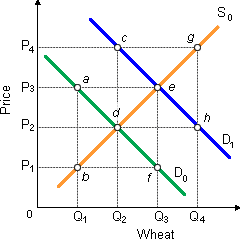
1159_examle of Total Revenue.png

How can I solve my economics problem? Please suggest me the correct answer.

   Related Questions in Microeconomics

  • Q : Effects of Moral Hazard When you pay a

    When you pay a straight A student in advance to write your term-paper and that person spends money on the party and then decides not to do a fine job and hence you wind-up with an F for submitting sloppily written gibberish, you have just suffered since of: (i) Advers

  • Q : Problem on demand for Inferior Goods I

    I have a problem in economics on demand for Inferior Goods. Please help me in the following question. When income rises, demands for: (1) Substitute goods reduce. (2) Inferior goods reduction. (3) Normal goods reduction. (4) Complementary goods rise.<

  • Q : Rational Investments and Sunk Costs

    Decisions are most obviously less than perfectly rational while: (1) you take a shortcut through a dark alley at 3:00 am to get home faster. (2) a brilliant student majors into art history in place of economics. (3) prisoners on death row in Texas know that tobacco ca

  • Q : Policies for overall demanding labor

    Policies which raise the overall demand for labor and maintain unemployment rates low are: (w) significant for the success of any other programs to reduce poverty. (x) sufficient measures to reduce the incidence of poverty. (y) not relevant to the suc

  • Q : Substitution and elasticity of good The

    The price elasticity of demand is probable to be greater the: (1) more extensively the good is seems as a need. (2) better the obtainable alternatives for producers. (3) higher the opportunity costs of production. (4) larger the number of utilizes for

  • Q : Law of demand in Ceteris Paribus Can

    Can someone help me in finding out the right answer from the given options. The law of demand supposes that the income and tastes of the consumers are: (i) Strong determinants of the prices. (ii) Causes of movements all along the demand curve. (iii) C

  • Q : Problem on average retail price and the

    Table indicate the average retail price of milk and the Consumer Price Index in the year 1980 -1998. 1010_Average</span></p>
                                        </div>
                                        <!-- /comment-box -->
                                    </li>
   
   </td>
	</tr><tr>
		<td>
       
      <li>
                                        <div class=

    Q : Determine total revenue when maximizes

    Total revenue when this firm maximizes economic profits would be: (w) $72,000 per period. (x) $80,000 per period. (y) $96,000 per period. (z) $100,000 per period.

    Q : Problem on I-Proprietorships The

    The business owned and operated by the lone individual is a/an: (i) Unit of labor. (ii) Entrepreneurship. (iii) Corporation. (iv) Sole proprietorship. Can someone please help me in finding out the accurate answer from the above opt

  • Q : Price ceilings and price floors Price

    Price ceilings and price floors: 1) cause surpluses and shortages respectively. 2) make the rationing function of free markets more efficient. 3) interfere with the rationing function of prices. 4) shift demand and supply curves and therefore have no effect on the rat