--%>

Determine the new per unit cost of production

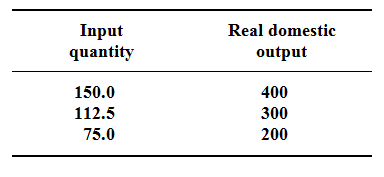
Assume that the hypothetical economy had the given relationship among its real domestic output and the input quantities essential for producing that level of output:
 

212_relation of hypothetical economy.png

Suppose that the input price rise from $2 to $3 along with no accompanying change in productivity. Determine the new per unit cost of production? In what direction did the $1 rise in input price push the aggregate supply curve? Determine effect of this shift in aggregate supply upon the price level and the level of real output?

E

Expert

Verified

The AS curve would shift leftward. The price level would increase and real output would fall.

   Related Questions in Finance Basics

  • Q : What is Service Revolving Fund Service

    Service Revolving Fund: A fund employed to account for and finance most of the client services provided by the Department of General Services. The amounts expended by the fund are repaid by sales and services priced at rates adequate to keep the fund

  • Q : What do you mean by the term Year of

    Year of Appropriation (YOA): It refers to the initial year of an appropriation.

  • Q : What is a fund Fund: A lawful budgeting

    Fund: A lawful budgeting and accounting entity which offers for the segregation of moneys or other resources in the State Treasury for obligations in accordance with particular restrictions or limitations. A separate set of accounts should be maintain

  • Q : Explain the term Balance Available

    Explain the term Balance Available: In regards to a fund, it is the surplus of resources over uses. For budgeting aims, the balance accessible in a fund condition is the carry-in balance, net of any preceding year adjustments, plus revenues and transf

  • Q : Define Allocation Allocation : The

    Allocation: The distribution of funds or costs from one account or misuse to one or more accounts or appropriations (example, the allocation of employee compensation funding from the statewide 9800 Budget Act items to the departmental Budget Act items

  • Q : Explain Generally Accepted Accounting

    Generally Accepted Accounting Principles (GAAP): The accounting rules, principles, conventions, and procedures which are employed for accounting and financial reporting. The GAAP for governments are put by the Governmental Accounting Standards Board (

  • Q : Do mergers result in layoffs Do mergers

    Do mergers result in layoffs?Entire employment in the banking industry in fact has increased slightly over the last ten years. Some mergers do result in layoffs. Though, several banks demolish their staff largely through attrition to ease the tr

  • Q : Describe Form 9 Form 9 : It is the

    Form 9: It is the request by department for space planning services (example, new or extra space lease extensions, or renewals in non-institutional) and also evaluated by the Department of Finance.

  • Q : Explain Conference Committee Conference

    Conference Committee: It is a committee of three members (that is two from the majority party and one from the minority party) from each house, appointed to gather and resolve differences among versions of a bill (example, when one house of the Legisl

  • Q : Influence of opportunity costs How do

    How do opportunity costs influence the capital budgeting decision-making procedure? Opportunity costs reflect the foregone benefits of alternative not selected when a capital budgeting project is chosen. Any decrease in the cash flows of the fi