--%>

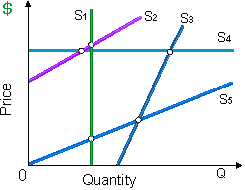
Determine supply curve as perfectly price-inelastic

Suppose that all these given demonstrated curves in below are infinitely long straight lines. There supply curve that is perfectly price-inelastic is: (i) supply curve S1. (ii) supply curve S2. (iii) supply curve S3. (iv) supply curve S4. (v) supply curve S5.
580_Price Elasticity of Supply1.png

How can I solve my Economics problem? Please suggest me the correct answer.

   Related Questions in Microeconomics

  • Q : Effect of change in market price I have

    I have a problem in economics on Effect of change in market price. Please help me in the following question. The change in quantity demanded is: (1) Non-quantitative in nature. (2) Caused by the change in market price. (3) Shown by the shift of demand curve. (4) Irrel

  • Q : Demand curves of monopolistic

    Monopolistic competitive firms face: (w) perfectly elastic demand curves. (x) perfectly inelastic demand curves. (y) downward sloping demand curves. (z) the industry demand curves. Hello guys I want your advice. Pl

  • Q : Kinked demand curves and sticky prices

    Sticky prices within oligopoly markets are: (w) predicted by the kinked demand curve model. (x) substantiated by many statistical studies. (y) most common for highly differentiated products. (z) a result of price discrimination.

    Q : Diseconomies of scale problem Can

    Can someone help me in finding out the right answer from the given options. When the average production costs rise as the total production of a firm rises, the firm is experiencing: (1) economies of scale. (2) Economies of scope. (3) Diseconomies of scope. (4) Disecon

  • Q : Critics of the simple limit pricing

    Critics of the straightforward limit pricing strategy argue about that: (w) sunk costs are not important in deterring entry. (x) for limit pricing to work, there should be a credible threat to keep old output levels. (y) this is rational to expect the

  • Q : Definition of Consumer Surplus The

    The difference among the price a consumer would have been eager to pay for the commodity and the price consumer really has to pay is termed as: (i) Gain. (ii) The substitution effect. (iii) The income effect. (iv) Consumer surplus.

  • Q : Determine wedges in demand and supply

    “Wedges” in between demand and supply curves are generated by: (1) arbitragers and speculators. (2) intermediaries and transaction costs. (3) development in the level of national income. (4) politicians who enact laissez f

  • Q : Oligopoly and economic welfare in long

    In an oligopoly, as opposite to monopolistic or pure competition, industry output within the long run is probable to be: (1) lower along with reduced prices. (2) about similar but with higher prices. (3) lower and with higher prices.

  • Q : Monopsony how do you determine

    how do you determine equilibrium for nurses in a monopsony

  • Q : Determine total revenue when price

    When the parents of newborns are relatively insensitive to changes within the price of Pampers diapers, in that case while the price of Pampers increases, total revenue to: (w) consumer increases. (x) seller increases. (y) consumer de