--%>

Determine short-run supply curve

When curve C reflects the long run supply curve for this industry as in illustrated figure, in that case the short-run supply curve would be: (i) curve A. (ii) curve B. (iii) curve C. (iv) curve D. (v) curve E.
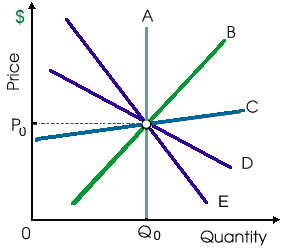
1149_purely competitive industry.png

I need a good answer on the topic of Economics problems. Please give me your suggestion for the same by using above options.

   Related Questions in Microeconomics

  • Q : Public utilities in natural monopoly

    Public utilities are generally: (1) regulated natural monopolies. (2) competitive non-profit corporations. (3) consequences of diseconomies of scale in production. (4) only subject to laissez-faire regulation. (5) operated by the federal government.

  • Q : Unimportant economies of scale If

    If comparing market structures, when economies of scale are unimportant: (w) the most efficient form of market structure is a pure monopoly. (x) purely competitive industries and price discriminating monopolies are equally efficient. (y) price discrim

  • Q : Relatively price inelasticity of demand

    When cuts into the price of cowboy hats drive down total revenues to hat makers, in that case demand: (1) relatively price elastic. (2) relatively price inelastic. (3) unitarily price elastic. (4) infinitely price elastic. (5) zero pr

  • Q : Horizontal summation of individual

    The purely competitive industry’s demand for the labor is: (i) Less elastic than the horizontal summation of individual firm’s demands. (ii) Perfectly elastic. (iii) Upward sloping as of the diminishing marginal returns to labor. (iv) Equi

  • Q : Spread of wage information The

    The Employers frequently discourage the spread of wage information since they fear that: (i) Lower salaried workers might use the information to negotiate the raises. (ii) Firms honor employee’s privacy only when secrecy is reciprocated. (iii) Unions try to orga

  • Q : Occurrence of increase in supply in

    In short run, the increase in supply takes place whenever the: (1) Supply curve shifts upward and to left. (2) Preferences of consumers change in a positive direction. (3) Market price raise. (4) Amounts producers make accessible rise at each and every price. (5) Publ

  • Q : Relationship between MPS and multiplier

    Relationship between MPS and multiplier:K=1/1-MPC = 1/MPS or inverse relationship between MPS and the size of multiplier.

  • Q : The Reciprocal Trade Agreements Act

    Select the right ans wer of the question. The Reciprocal Trade Agreements Act: 1) exempted American exporters from the Sherman Antitrust Act. 2) provided technological assistance to developing countries. 3) brought about considerable reductions in American trade barri

  • Q : Purely competitive and monopolistic

    Which one is correct ? A) Both purely competitive and monopolistic firms are "price takers." B) Both purely competitive and monopolistic firms are "price makers." C) A purely competitive firm is a "price taker," while a monopolist is a "price maker." D) A purely compe

  • Q : Define Marginal rate of transformation

    Marginal rate of transformation: This is the amount of one good which should be given to generate one additional unit of a second good. This is also termed as marginal opportunity cost.