--%>

Determine prise when demand decrease and supply increase

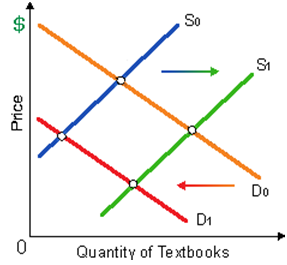
In this market for textbooks, demand has transferred from D0 to D1 and supply varied from S0 to S1. Such market for textbooks has experienced as: (w) a raise in demand and supply. (x) a reduce in demand and supply. (y) a raise in supply and a reduce in demand. (z) a raise in demand and a reduce in supply.
1973_demand for textbooks.png

How can I solve my economics problem? Please suggest me the correct answer.

   Related Questions in Microeconomics

  • Q : Problem on sole Proprietorships I have

    I have a problem in economics on Problem on sole Proprietorships. Please help me in the following question. The form of business association with the greatest potential financial liability for its owners is the: (1) Corporation. (2) Sole proprietorshi

  • Q : Market period disequilibrium At the

    At the price P1, this purely competitive Christmas tree industry is within: (w) long-run equilibrium. (x) short-run equilibrium. (y) market period disequilibrium. (z) short-run disequilibrium.

    Q : Explain about supply curve A supply

    A supply curve which is: (i) vertical is perfectly price elastic. (ii) horizontal is perfectly price inelastic. (iii) linear and goes through the origin has a price elasticity of one. (iv) rectangularly hyperbolic is also unitarily elastic. (v) trapez

  • Q : Elasticity of demand changes with price

    Calculating the price elasticity of demand for DVD games for a price variation from $50 to zero in such demand curve is: (w) 0. (x) infinity. (y) mostly meaningless since elasticity changes continuously over such range. (z) 1.5.

    Q : Total demand for money How do you

    How do you determine the total demand for money. In a graph, what is demand contingent upon?

  • Q : Market Power and Demand for Labor All

    All of the given might causes labor markets to be non-competitive except: (i) Backward bending labor supply curves. (ii) Unions and employer trade associations. (iii) Monopolistic power exercised by the firm. (iv) Monopsonistic power exercised by the

  • Q : Consumer Surplus-Difference in amounts

    Kiley pays $1.00 for the cold Pepsi on a hot afternoon, however would be willing to pay $5.00. The $4.00 difference in such amounts is her: (i) Consumer surplus. (ii) Income effect. (iii) Economic gain. (iv) Marginal utility. (v) Pleasure coefficient.

    Q : Legal barriers to entry in a market

    Governmentally-imposed obstacles to the entrance of new firms within a market are termed as: (1) regulatory barriers or legal barriers to entry. (2) strategic barriers to entry. (3) natural barriers to entry. (4) tax barriers to entry. (5) revenue blockades.

  • Q : Marginal revenue for purely competitive

    For a purely competitive firm and for a nondiscriminating unregulated monopolist, the marginal revenue is: (1) identical to the price per unit of output. (2) equal to marginal cost when profit is maximized. (3) greate

  • Q : Problem Regarding to Contestable Markets

    Even though the concentration ratio for an oligopoly is close to hundred, firms may operate rather efficiently when the market: (1) price conforms to a limit pricing model. (2) is contestable since entry and exit are easy. (3) demand curve is unitaril