--%>

Determine prices for demand of buyers and supply of sellers

Buyers' demand prices would be ____ and sellers' supply prices would be ____ when the U.S. restricted car imports to Q1. (w) P2 and P1. (x) P0 and P2. (y) P0 and P2. (z) P1 and P2.
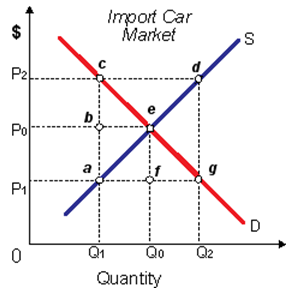
1896_Trade Barriers.png

Can anybody suggest me the proper explanation for given problem regarding Economics generally?

   Related Questions in Microeconomics

  • Q : Asset demand Select the right answer of

    Select the right answer of the question. The asset demand for money: A) is unrelated to both the interest rate and the level of GDP. B) varies inversely with the rate of interest. C) varies inversely with the level of real GDP. D) varies directly with the level of nom

  • Q : Needs of Wage Discrimination Can

    Can someone please help me in finding out the accurate answer from the following question. The Wage discrimination needs a firm to possess: (1) Monopsony power. (2) Monopoly power. (3) Oligopoly power. (4) None of these—no po

  • Q : Market interest rates for different

    Market interest rates for different financial assets are positively associated to the: (w) expected rate of inflation. (x) liquidity of the assets. (y) efficiency of financial intermediation. (z) preferences of people about consuming in the future ins

  • Q : Monopolists maximize profits Maximizing

    Maximizing the net social benefits from a specified stock of resources does NOT need that: (i) price equals marginal cost for all goods. (ii) marginal social benefit equals marginal social cost [MSB = MSC]. (iii) no one can be made better off unless s

  • Q : Markets in a capitalistic economy

    Markets within a capitalistic economy answer the “What?” question with: (1) government subsidies which promote new technologies. (2) giving those goods which consumers demand. (3) misleading advertising to persuade consumers to buy. (4) di

  • Q : Firms in purely competitive markets

    Firms within purely competitive markets as: (1) practice price discrimination more often than do firms along with market power. (2) do not price discriminate since they are more interested in their customers than are monopolists. (3) cannot price disc

  • Q : Reduced monopoly power by oligopolistic

    The allocative inefficiency commonly related with the exercise of market [i.e., monopoly] power tends to be reduced when oligopolistic firms: (1) differentiate their products by competitive advertising. (2) price discriminate based upon the price elas

  • Q : When did marginal utility diminished

    The marginal utility most obviously diminished whenever: (1) Eric sang six songs rather than only one on karaoke night at local club. (2) Molly’s piano lessons absorbed 20 hrs last week she could have used up for studying. (3) Karen built 12 boxes however only 9

  • Q : Problem regarding rise in quantity

    Can someone please help me in finding out the accurate answer from the following question. The raise in the quantity supplied of frozen vegetarian lasagna would be most probable to outcome from raise in the: (i) cost of ingredients in the vegetarian lasagna. (ii) Numb

  • Q : Supply in short-run equilibrium When a

    When a purely competitive industry is within short-run equilibrium, this: (w) should also be in long-run equilibrium. (x) won’t be in long-run equilibrium. (y) may or may not be within long-run equilibrium. (z) will experience m