--%>

Determine prices by maximize total revenue

LoCalLoCarbo that is Favorite Corporation of fad dieters, which can maximize its total revenue when this produces: (1) output q2 and charges a price equal to P1. (2) output q3 and charges a price of more than P2 although less than P1. (3) output q* and charges a price of more than P2 but less than P1. (4) output q4 and charges a price equal to P2. (5) output q5 and charges a price of more than P3 although less than P2.
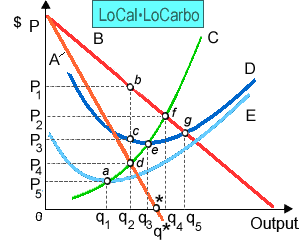
2407_Market Power and Marginal Revenue.png

Can anybody suggest me the proper explanation for given problem regarding Economics generally?

   Related Questions in Microeconomics

  • Q : Long-run equilibrium price and output

    Long-run output and equilibrium price combinations describe a purely competitive industry’s: (w) demand curve. (x) long-run supply curve. (y) expansion path. (z) contract curve. I need a good answer on the to

  • Q : Price elasticity and market power The

    The price elasticity of demand equals one when this firm produces where total revenue is: (i) $72,000 per period. (ii) $80,000 per period. (iii) $96,000 per period. (iv) $100,000 per period. (v) $144,000 per period.

    Q : Boosting total revenue by elastic price

    Price hikes for DVD games will boost total revenue providing the price is: (w) located on this demand curve. (x) above $30. (y) below $30. (z) below $25.

    Q : Define cost Cost : This refers to the

    Cost: This refers to the money expenses acquired on the production of a specified amount of commodity.

  • Q : Supply in the short run and long run

    Supply is too elastic (contain a smaller coefficient) within the long run than in the: (w) short-run in competitive, constant-cost industries. (x) short-run in competitive, increasing-cost industries. (y) market period in virtually all industries. (z) All of the above

  • Q : Marginal revenue at possible output

    At each possible output level, there a purely competitive firm’s marginal revenue curve is: (w) above its demand curve. (x) below its demand curve. (y) identical along with its demand curve. (z) steeper than its demand curve.

    Q : Problem on change in preferences Can

    Can someone help me in finding out the right answer from the given options. Tim liked to snack on slim jims on fishing; however his friend Earl for all time brought beef jerky. Tom slowly developed a taste for jerky and at present buys it more frequently than slim jim

  • Q : Problems regarding Attributes of Goods

    I have a problem in economics on Problems regarding Attributes of Goods. Please help me in the following question. The intrinsic characteristics which make or detract from the satisfaction derived from consuming a good are termed as: (1) Attributes. (2) Factors. (3) U

  • Q : Characteristics of constant cost

    Characteristics of industries which are not characteristics internal to operations of an individual firm include: (1) potential principal-agent problems. (2) diseconomies of scale. (3) production costs which either increase or decrease like the size of a market not su

  • Q : Pretax -posttax and transfer

    Refer to the following diagram. If line b represents the pretax and transfer distribution of income in the United States, we would expect the post-tax and transfer distribution to be: A) line a. B) line b, because taxes and transfers have no effect on income distribut