--%>

Determine most price elastic in curve

The part of this supply curve for 2×4s which is most price elastic is in between: (i) point a and point b. (ii) point b and point c. (iii) point c and point d. (iv) point d and point e. (v) point e and point f.
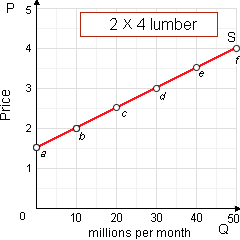
385_Price Elasticity of Supply2.png

I need a good answer on the topic of Economics problems. Please give me your suggestion for the same by using above options.

   Related Questions in Microeconomics

  • Q : Define progressive in taxes as

    Line T0 depicts a tax system which is: (1) progressive. (2) recessive. (3) proportional. (4) biased. (5) regressive. 1577_</span></p>
                                        </div>
                                        <!-- /comment-box -->
                                    </li>
   
   </td>
	</tr><tr>
		<td>
       
      <li>
                                        <div class=

    Q : Market adjustments through a scarce good

    Within below figure there is market for papayas: (1) a shortage exists at P2. (2) papayas are a free good at P0. (3) papayas are currently a scarce good. (4) consumer's demand prices equivalent P2 at quantity Q2. (5) the equ

  • Q : Problem on deadweight loss Assume that

    Assume that the domestic demand for television sets is explained by Q = 40,000 − 180P and that the supply is provided by Q = 20P. When televisions can be freely imported at a price of $160, then how many televisions would be generated in the domestic market? By

  • Q : Labor Force Participation Rates The

    The percentage of a specified population who are either unemployed or employed is termed as the: (1) labor force participation rate. (2) work-force proportion. (3) labor supply. (4) substitution effect dominance rate. (5) income-leisure loss curve.

    Q : Union-Nonunion Wage Differentials I

    I have a problem in economics on Union-Nonunion Wage Differentials. Please help me in the following question. All else equivalent, when employment in an industry raises, the average wage differential gap among union and non-union workers: (1) Narrows.

  • Q : Principal-Agent Problems-Institutions

    According to the John Kenneth Galbraith, the modern corporate planning: (i) Aims at decreasing risks to the managers of main firms. (ii) Stresses the maximization of gains. (iii) Is much concerned with the social goals. (iv) Maximizes the social welfare.

  • Q : Stickiness of prices in oligopolistic

    The "kinked-demand-curve" model was developed into the 1930 year in part to help describe: (i) barriers to entry in oligopoly markets. (ii) the allegedly excessive stickiness of prices into oligopolistic industries. (iii) how competitive industries be

  • Q : Fixed cost in long run Can there be

    Can there be certain fixed cost in long run? If not why? Answer: No, there can’t be any fixed cost in long run. The main reason is that there is no fixed inpu

  • Q : Problem on cross-price elasticity Kathy

    Kathy purchases two goods, t-shirts and caps.  Her demand for t-shirts is: Qt = 44 – 3Pt - Pc + .04IThe price of caps is Pc = $2. And her income is I = $300.a. Graph a demand curve for Kathy’s t-shirts.

  • Q : Positive sloped labor supply curve Can

    Can someone help me in finding out the right answer from the given options. The monopsonist in labor market faces a: (1) Totally elastic demand for labor. (2) Completely elastic supply of the labor. (3) Completely inelastic supply of the labor. (4) Positively sloped l