--%>

Determine marginal revenue and marginal costs

While this firm maximizes economic profits, in that case marginal revenue and marginal costs would be: (1) $4 per unit. (2) $6 per unit. (3) $8 per unit. (4) $10 per unit. (5) $12 per unit.
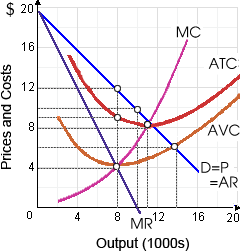
106_Price Discrimination.png

Hello guys I want your advice. Please recommend some views for above Economics problems.

   Related Questions in Microeconomics

  • Q : Kinked demand curve model of

    The kinked demand curve model of oligopolistic pricing behavior reflects the concept which: (1) price hikes fail to accommodate small hikes in costs. (2) other firms ignore price hikes by single firms. (3) other firms match any price cuts by any singl

  • Q : Demand when total revenue uninfluenced

    When total revenue to a firm is uninfluenced by small price changes, in that case demand is: (1) relatively price elastic. (2) relatively price inelastic. (3) unitarily price elastic. (4) vertical. (5) horizontal.

  • Q : Question on elasticity of demand Select

    Select the right ans wer of the question. The demand for agricultural products is: A) relatively elastic with respect to price. B) relatively inelastic with respect to price. C) relatively elastic with respect to income. D) downward sloping to the individual farmer, b

  • Q : Variation in price elasticity as price

    The only supply curve which has price elasticity which varies as the price of output increases is within: (w) Panel A. (x) Panel B. (y) Panel C. (z) Panel D.

    Q : Demand in price inelastic region

    HoloIMAGine will never deliberately generate and sell holographic technology at an output level where is: (w) marginal revenue [MR] is positive. (x) demand is in a price-elastic region. (y) marginal revenue [MR] is falling. (z) demand is in a price-in

  • Q : Labor Unions and Wage Differentials The

    The counter-argument to the idea which unions cause inflation is that the union negotiated wage hikes: (i) Are not excessive except W > average revenue products. (ii) Set the pattern for non-union wage negotiations. (iii) Tend to outcome in lower salaries in non-un

  • Q : Problem on Substitute Goods Can someone

    Can someone help me in finding out the right answer from the given options. The substitute goods are: (i) Usually consumed altogether. (ii) Inferior to luxury goods. (iii) Generally free goods. (iv) Replacements for each other.

    Q : Market demand function The market  for

    The market  for good X consists  of 2 consumers. consumer  1',s demand  for good X is: X1 :  15 - 3Px + 0.5PY + .02I1I1 and I2 a

  • Q : Profits and losses in long run In the

    In the long run: (i) purely competitive firms make zero economic profits. (ii) monopolistically competitive firms make zero economic profits. (iii) effective barriers to entry may permit economic profits. (iv) oligopolists and monopolists may realize

  • Q : Firms in purely competitive markets

    Firms within purely competitive markets as: (1) practice price discrimination more often than do firms along with market power. (2) do not price discriminate since they are more interested in their customers than are monopolists. (3) cannot price disc