--%>

Determine least price elasticity in market

Of all of the known ranges on such supply curves, the supply of tanks of dehydrated water is least price elastic in between: (i) point a and point b. (ii) point b and point c. (iii) point c and point d. (iv) point e and point f. (v) point g and point h.
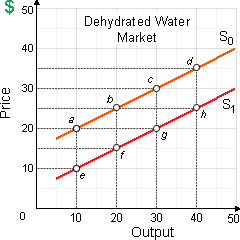
1011_Price Elasticity of Supply.png

Please choose the right answer from above...I want your suggestion for the same.

   Related Questions in Microeconomics

  • Q : Lacking of competition in the product

    Can someone help me in finding out the right answer from the given options? The lack of competition in the product market outcomes in: (1) Less labor being appointed than if the markets were competitive. (2) More labor being hired than if the markets were competitive.

  • Q : Intermediate Oligopoly Why is demand

    Why is demand curve is beneath oligopoly indeterminate (i.e., uncertain)? Answer: Demand curve is indeterminate since of price war among sellers.

  • Q : Change in prices after short run demands

    Can someone please help me in finding out the accurate answer from the following question. The changes in gasoline prices do not change short-run demands for (1) Bigger versus smaller cars. (2) Gasoline. (3) Alternative forms of the transportation. (4) Batteries, Tire

  • Q : Positively sloped resource supply curves

    When the resource supply curves of facing a competitive industry are positively sloped, in that case the exit of firms which have incurred losses will result within: (w) higher prices and lower output by each firm, and higher average production costs.

  • Q : Practicing predatory pricing by a

    This is difficult to convict a company for practicing predatory pricing since: (w) the degree of economic analysis needed is beyond the understanding of most lawyers. (x) this is not illegal to practice predatory pricing. (y) this is frequently hard t

  • Q : Influences on union nonunion wage

    Significant influences on union non-union wage differentials comprise the: (1) Proportion of an industry which is unionized and the frequency of strikes. (2) Frequency of strikes, inflation and the collective bargaining policies. (3) Collective bargai

  • Q : Trends in Income Distribution The year

    The year in that a long-run trend towards greater equality within the U.S. income distribution was reversed, therefore income since then has become less equally distributed, it was roughly: (w) 1945. (x) 1960. (y) 1975. (z) 1990.

    Q : Substitution effects resulting from

    The Law of Demand mainly relies heavily on the: (1) Buying power consequences of relative price modifications. (2) Substitution effect resultant from the relative price changes. (3) Increase in opportunity costs as income is worn out. (4) Principle of the non satiety.

  • Q : Attract aggressive competition by high

    There is substantial evidence which: (w) size alone protects modern corporations from competitive pressures. (x) big unions manipulate government more than big business does. (y) the marketplace serves business firms better than consumers. (z) high pr

  • Q : Specific market price The difference

    The difference among maximum amount which consumers would willingly pay for a particular quantity of a good and the amount they really pay at a specific market price is termed as: (i) Discount rate. (ii) Mark-up factor. (iii) Familial gains. (iv) Hous