--%>

Determine average variable cost in curve

As din demonstrated curve J in below is this Christmas tree: (w) industry’s supply curve. (x) firm’s demand curve. (y) firm’s average variable cost curve. (z) firm’s short-run supply curve.
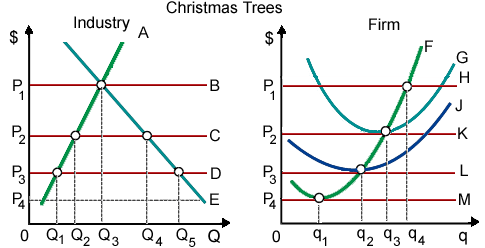
579_supply and demand1.png

Hey friends please give your opinion for the problem of Economics that is given above.

   Related Questions in Microeconomics

  • Q : Output produced by profit maximizing

    A profit maximizing monopolist produces output where: (i) MR = MC as long as the corresponding price exceeds average variable costs [P>AVC]. (ii) marginal revenue minus marginal costs [MR - MC] is maximized. (iii) price minus average cost is maximi

  • Q : Question on economic cost Select the

    Select the right answer of the question. Which of the following is not an economic cost? A) wages. B) rents. C) economic profits. D) normal profits.

  • Q : Short-run and long-run average total

    A firm generating where MC = SRAC = LRAC operates at the minimum point of its: (w) short-run and long-run average total cost curves. (x) long-run total cost curve. (y) total physical product of labor curve. (z) maximum profit curve.

    Q : Complication in accusation of predatory

    An accusation of predatory pricing is complicated to prove within a court of law since: (w) firms generally have too much power. (x) consumers and juries like the low prices and are less likely to fine a firm for lowering price. (y) predatory behavior

  • Q : Meaning of term competition in Economic

    Economists generally use the word “competition” to refer to: (w) negotiations among buyers and sellers. (x) a type of market structure in that competitors are price takers and, occasionally, to rivalrous processes among firms. (y) how pric

  • Q : How Accounting profits differ from

    Can someone please help me in finding out the accurate answer from the following question. The Accounting profits differ from economic profits in such a manner that: (1) Accounting profits take into account of opportunity costs, whereas economic profits take into acco

  • Q : Income and Substitution effects problem

    Economists decompose how the consumers react to a change in price of a good into the: (1) Diminishing marginal utility effect and indifference effect. (2) Indifference effect and enhancement effect. (3) Net utility effect and preference effect. (4) Income effect and s

  • Q : When is demand perfectly price inelastic

    Demand is perfectly price inelastic when the quantity demanded for Pixie’s cheesy fried grits is of: (w) zero. (x) P4. (y) P2. (z) More information is required.

    Q : Theory of the Firm The advantages that

    The advantages that firms confer on society do not comprise: (i) Decreasing the transaction costs. (ii) Raising consumer purchasing power. (iii) Facilitating the specialization in production. (iv) Raising the consumer demand. (v) Boosting the national income.

  • Q : Intermediaries earn income to help

    In the long run within a market system, all intermediaries earn income only when they help sellers and buyers: (w) raise surpluses. (x) by innovating new products. (y) reduce transaction costs. (z) ga