--%>

Describe Timers

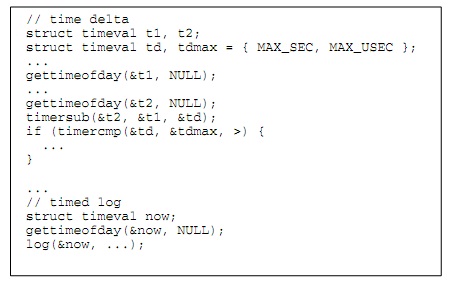
Timers: While time values usually cannot be reduced in the target system, their usage can be encapsulated as an abstraction which can be replaced easily (e.g., by a non-deterministic choice) during model checking.

The following code shows two typical operations involving time implemented in C/C++: calculating a time delta between two execution points, and logging the current time at a specific point in the execution:
881_timers.jpg

   Related Questions in Programming Languages

  • Q : Homework Assignment How much would it

    How much would it cost to do a basic program within the given requirements?

  • Q : Define way of kernel object outlive

    Explain the way of the kernel object outlive the process which created it.

  • Q : Write a program and estimate pi using

    Consider a dartboard of radius 1. Since the area of the board will be  π r2 = π * 1 *1, it's clear the area of the dartboard is exactly π. The area of a square surrounding the board (circumscribing it) would be 2*2 = 4, sin

  • Q : Explain the term QTP Environment

    Explain the term QTP Environment?

  • Q : Explain Method overriding Method

    Method overriding: It is a method stated in a super class might be overridden by a method of similar name stated in a sub class. The two methods should have similar name and number and types of formal arguments. Any checked exception thrown by sub-cla

  • Q : Program and process Explain the term

    Explain the term program and process?

  • Q : Define Unbounded repetition Unbounded

    Unbounded repetition: The repetition where statements in a loop's body are executed an arbitrary number of times, according to the consequences of the statements in the loop's body. All of the loop control structures in the Java offer for unbounded re

  • Q : Explain Program counter Program counter

    Program counter: A program counter is an integral portion of a computer's Central Processing Unit. It includes a reference to the memory address of the subsequent instruction to be fetched, ready to be executed throughout the next fetch-execute cycle.

  • Q : Explain Untyped Allocations Untyped

    Untyped Allocations: In C/C++ untyped allocations such as malloc, calloc, and realloc can easily be used to create overlays, which again require translation overhead to keep the corresponding non-overlaid objects consistent.

    Q : What is Append mode Append mode : It is

    Append mode: It is a file writing mode, in which the existing contents of a file are maintained whenever the file is opened. Novel contents are appended to the existing.