--%>

Describe factors cause change in aggregate demand

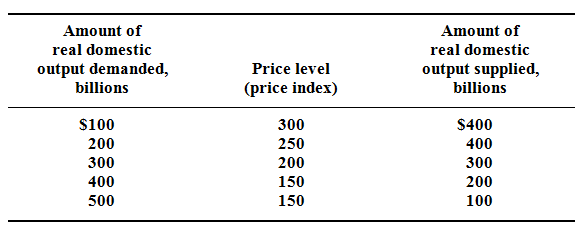
Assume that aggregate demand and the short run supply for a hypothetical economy are as illustrated below:
1855_Hypothetical economy.png

Assume that buyers wish to purchase $200 billion of extra real domestic output at each price level. Describe factors might cause this change in aggregate demand? Describe the new equilibrium price level and level of real output?

E

Expert

Verified

Rise in consumer, government, investment or net export spending might shift the AD curve rightward. New equilibrium price level is 250. New equilibrium GDP will be $400 billion.

1617_aggregate demand and supply curves.png

   Related Questions in Finance Basics

  • Q : Advantages of corporation in countries

    Describe some primary advantages while a corporation has operations in countries other than its home country? Explain risks? Foreign operations may decrease a company's labour or material costs, and may raise its sales. Risks comprise possible

  • Q : Describe risk aversion Describe risk

    Describe risk aversion? Risk aversion is the tendency to ignore additional risk. Risk-averse people will ignore risk if they can, unless they attain additional compensation for letting that risk. In finance, the added compensation is a higher ex

  • Q : Mascot Simulation Simulation with

    Simulation with Crystal Ball Provided Workbook: Mascot Simulation Relevant Readings:"Discounted Cash Flow Modeling" folder + Text

  • Q : Illustrate a market of fictitious

    Illustrate a market wherein the equilibrium dollar price of one unit of fictitious currency Zee is $5 (the exchange rate is $5 = Z1). Then illustrates on your diagram a decline in the demand for Zee. a. Referring to this diagram, d

  • Q : Pros and cons of commercial paper

    Describe pros and cons of commercial paper associated to bank loans for a company seeking short-term financing? Usually commercial paper is a cheaper source of short-term financing for a firm, compared to bank loans. Also, a larger amount of fu

  • Q : Describe the risk-return relationship

    Describe the risk-return relationship.The relationship among risk and required rate of return is term as the risk–return relationship.  This is a positive relationship since the more risk assumed, the higher the required rate of retur

  • Q : Define Workload Workload : The

    Workload: The measurement of rises and reduces of inputs or demands for work, and an ordinary basis for projecting related budget requires for both established and new programs. This approach to BCPs is frequently viewed as an alternative to outcome o

  • Q : Pitfalls when two companies merge Other

    Other than pricing, some pitfalls that consumers might have to deal with when two major companies merge.

  • Q : What is Carryover Carryover : The

    Carryover: The unencumbered equilibrium of an appropriation which continues to be obtainable for expenditure in years following to the year of enactment. For illustration, when a three-year appropriation is not completely encumbered in the first year,

  • Q : Does high operating leverage mean high

    Does high operating leverage for all time mean high business risk? Describe. High operating leverage does not for all time mean high business risk. If the company's sales are fairly stable then the variation into operating income would be smal