--%>

Derive the long-run aggregate supply curve

For a hypothetical economy, suppose the full employment level of real output (Q) will be $250 and the price level (P) firstly is 100. Employ the short-run aggregate supply schedules below to answer the questions that follow:
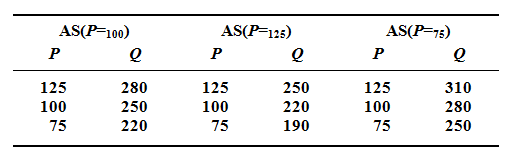
120_short-run aggregate supply schedules.png

Demonstrate the circumstances explained in parts a and b on graph paper, and derive the long-run aggregate supply curve.

E

Expert

Verified

Short-run AS: P1 = 100; P2 = 125; P3 = 75; and Q1 = $250; Q2 = $280; and Q3 = $220. Long-run aggregate supply = Q1 = $250 at each of the three price levels.

   Related Questions in Finance Basics

  • Q : Rate of inflation Normal 0 false false

    Normal 0 false false

  • Q : Influence of a quota Normal 0 false

    Normal 0 false false

  • Q : What is Reference Code Reference Code :

    Reference Code: A three-digit code recognizing whether the item is from the Budget Act or some other source (example, legislation), and its character (example, state operations). This is the middle segment of the budget item or appropriation number.

  • Q : What is Legislative Analysts Office

    Legislative Analyst’s Office (LAO): A non-partisan organization which gives advice to the Legislature on the fiscal and policy matters. For illustration, the LAO annually publishes a full analysis of the Governor's Budget and this document becom

  • Q : Define Federal Fiscal Year Federal

    Federal Fiscal Year (FFY): The twelve month accounting period of the federal government, starting on October 1 and ending the following September 30. For illustration, a reference to FFY 2013 means the period starting October 1, 2012 and ending at Sep

  • Q : What is Appropriation Without Regard To

    What is Appropriation Without Regard To Fiscal Year (AWRTFY): The appropriation for a particular amount that is obtainable from year to year until completely expended.

  • Q : Describe the primary variables in EOQ

    Describe the primary variables being balanced in the EOQ inventory model? Clarify In the EOQ model the primary variables being balanced are carrying costs and ordering costs. The more frequent orders are placed the lower the firm's carrying co

  • Q : Surpluses drive prices up- shortages

    Normal 0 false false

  • Q : Supply and demand 1. Albert Jones went

    1. Albert Jones went to his local department store to purchase a pair of Levi s. He thought that the style of Levi that he wanted would sell for about $30 a pair. When he got to the store, he saw a sign which said, Levi s, all styles, $18 a pair. Albert bought three pairs of Levi s. The behavior of

  • Q : Aggregate demand or aggregate supply

    Normal 0 false false