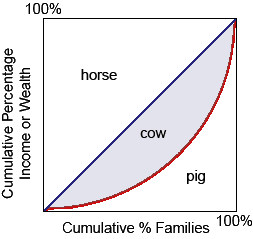
Demonstrates the Lorenz Curve
This given figure demonstrates as: (w) Lorenz curve. (x) familial income distribution graph. (y) Gini curve. (z) Blanc income standard curve. How can I solve my Economics problem? Please suggest me the correct answer.
This given figure demonstrates as: (w) Lorenz curve. (x) familial income distribution graph. (y) Gini curve. (z) Blanc income standard curve.
How can I solve my Economics problem? Please suggest me the correct answer.
I have a problem in economics on Generating utility through production. Please help me in the following question. The production generates utility by making a good more precious in: (1) Possession. (2) Time. (3) Form. (4) Place. (5) All the above. Q : Form of Discrimination The form of The form of discrimination which probably causes the smallest problems for income distribution is: (1) occupational discrimination. (2) human capital discrimination. (3) price discrimination. (4) personal discrimination. (5) employment discrimination.
The form of discrimination which probably causes the smallest problems for income distribution is: (1) occupational discrimination. (2) human capital discrimination. (3) price discrimination. (4) personal discrimination. (5) employment discrimination.
This capital market is within a closed private economy. Primary plans of savers and investors are demonstrated as curves S0 and I0. There Market equilibrium will exist at: (1) point a. (2) point b. (3) point c. (4) point d. (5) point
James and Louisa each have an income of $30, which they each spend on tomatoes and all other goods. They buy tomatoes at their local farmers market, which charges $3 per pound. Define the units for all other goods so that their price is $1 per unit.
The price makers in a purely competitive market are: (i) pure competitors or perfect competitors. (ii) producers of capital goods. (iii) pure oligopolies. (iv) monopolistic competitors. (v) pure monopolies. H
Reduction in the size of average American family is most probable to: (i) Erode rates of the technological advancement. (ii) Raise the demand for disposable diapers. (iii) Decrease women’s labor force participation rates. (iv) Increase the contribution of family
When average production cost for Plastibristle Inc. falls like market demand increases and more firms go into the industry, Plastibristle is within: (1) an economically efficient industry. (2) a purely competiti
The present value of an annual income stream which goes onto forever is: (w) infinite. (x) zero. (y) the annual income multiplied through the interest rate. (z) the annual income divided through the interest rate.
I have a problem in economics on Minimum Wage Laws. Please help me in the following question. Minimum wage legislation has been promotes as a technique to: (i) Make sure that workers are paid beneath the subsistence salaries. (ii) Perpetuate poverty. (iii) Maxim
Relative to firms into other market structures, there a profit-maximizing firm in an oligopoly: (1) is more efficient than firms in a perfectly competitive structure. (2) produces a larger level of output than firms within any other m
18,76,764
1958166 Asked
3,689
Active Tutors
1435894
Questions Answered
Start Excelling in your courses, Ask an Expert and get answers for your homework and assignments!!