--%>

Demonstrate supply curve for price elasticity of supply

The quantity supplied is ever more sensitive as output increases, therefore the price elasticity of supply raises as the price raises for the supply curve demonstrated in: (w) Panel A. (x) Panel B. (y) Panel C. (z) Panel D.
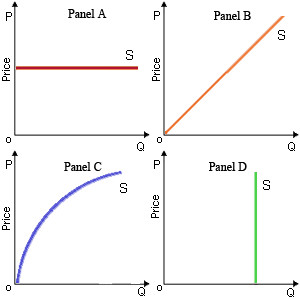
241_Slope and Price Elasticity of Supply.png

Can anybody suggest me the proper explanation for given problem regarding Economics generally?

   Related Questions in Microeconomics

  • Q : Characteristic of Vertical Integration

    Vertical integration is the characteristic of all firms which: (1) Control multiple features of the production of an output from raw materials to the retail sales. (2) Operate as international cartels, dealing mainly in non-renewable resources. (3) Mo

  • Q : World price in market When for wheat

    When for wheat the world price is $10 per bushel, and Del, who one owns the biggest wheat farm into North Dakota, will work at: (i) point a. (ii) point b. (iii) point c. (iv) point d. (v) point f.

    Q : Illustrate an example of arbitrage

    Purchasing oil into Kuwait for $22 per barrel and selling that you purchased for $30 per barrel into Sao Paolo is an illustration of: (w) speculation. (x) bifurcation. (y) a subsidy. (z) arbitrage. I need a good answer on the topic

  • Q : Excess supply for commodity When do we

    When do we state that there is an excess supply for the commodity in market? Answer: If at a given price the quantity supplied of a product surpasses its quantity d

  • Q : Poverty and Human Capital Enabling

    Enabling labor to move out of low-wage occupations by enhancing their education, skills, training and mobility, which will tend to: (w) lower the wages of those who leave the low wage occupation. (x) raise the wages of those who remain in the low wage

  • Q : Definition of Collective Bargaining The

    The procedure in which employers and unions agree to labor contracts which govern work arrangements is termed as: (i) Arbitration. (ii) Codependency. (iii) Bilateral monopoly. (iv) Joint profit maximization. (v) Collective bargaining.

    Q : Screening and Credentialism The critics

    The critics of ‘credentialism’ suppose that firms making employment decisions tend to mainly rely too heavily on: (i) Personal contacts. (ii) Personality testing. (iii) Past experience. (iv) Job interviews. (v) Formal education and trainin

  • Q : Economies of scale in natural monopoly

    Economies of scale which are substantial relative to market demand result within the market evolving to a: (w) contestable market. (x) collusive oligopoly. (y) natural monopoly. (z) "high tech" industry.

    Q : Perfectly Elastic Economic Rent A

    A uniform resource price paid for any resource which has an aggregate supply curve which is less than perfectly elastic generates an: (1) exploitation ratio. (2) investment surcharge. (3) accounting profit. (4) economic rent. (5) acce

  • Q : Pure competition and monopolistic

    Pure competition and monopolistic competition are: (1) polar opposites on the continuum of market structures. (2) the two market structures in that firms are pure quantity adjusters. (3) both characterized by an absence of barriers to long run entry a