--%>

Demand prices exceeds supply prices

When only Q0 papayas reached the market in that case: (1) desperate buyers would be willing to pay only P1 per papaya. (2) production costs would exceed P2 per papaya. (3) buyers would be indifferent regarding getting additional papaya. (4) the papaya surplus would generate widespread famine. (5) demand prices for papayas would exceed supply prices.
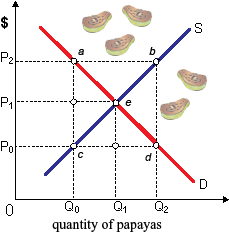
1827_example of Price Floors.png

Hello guys I want your advice. Please recommend some views for above economics problems.

   Related Questions in Microeconomics

  • Q : Purely competitive industry in market

    Within a purely competitive industry: (w) firm faces a perfectly elastic demand for its product. (x) market demand is completely elastic. (y) individual firms set prices for their output. (z) supply curve is based on fixed costs.

    Q : Least likely example of Substitution

    Can someone please help me in finding out the accurate answer from the following question. Assume that the War in Iraq spilled over into another oil exporting countries. When U.S. gasoline prices rose to, state, $10 per gallon, the least likely outcome would be that:

  • Q : Responsiveness of relative prices of

    Price cross elasticity of demand measures the responsiveness of: (1) quantity of a good sold to changes within its price. (2) quantity sold to changes within income. (3) price of one good to changes within the sales of other. (4) amount demanded of on

  • Q : Zero economic profit in long run When

    When the best a monopolist can do to produce an economic profit of zero, this will: (w) shut down in the long run. (x) shut down in the short run. (y) remain in operation in the long run. (z) raise its price to raise profit.

    Q : Economically inefficient level of output

    A monopolist produces an economically inefficient level of output since: (i) the difference among marginal revenue [MR] and marginal costs [marginal costs [MC] is maximized. (ii) P > average total costs [ATC], therefore MSB < MSC. (iii) all cons

  • Q : Copyrights in legal barriers to entry

    Legal barriers to entry do NOT comprise: (1) outright governmental prohibition of entry. (2) protection of inventions by patent. (3) licensing and bonding restrictions. (4) substantial economies of scale. (5) copyrights for music, computer software an

  • Q : Problems on Featherbedding The

    The Contracts needing employment after some worker’s jobs have been made outdated by automation are illustrations of: (1) Labor-reducing protectionism. (2) Featherbedding. (3) Check-off provisions. (4) Yellow dog contracts. (5) Blacklisting.

    Q : Determine the yearly total revenues

    When the U.S. wheat market as in below demonstrated graph is primarily within equilibrium on S0D0, in that case the yearly total revenues (price × quantity) of wheat farmers will equivalent: (1) 0P4gQ4

  • Q : Problem on wage discrimination Firms

    Firms which discourage the workers from discussing their salaries or wages are most likely engaged in the policies of: (i) Respect for the worker’s privacy. (ii) Monopolistic exploitation. (iii) Perfect competition. (iv) Cooperation rather than competition. (v)

  • Q : Surviving firms in declining

    When firms exit a declining competitive industry, in that case surviving firms will: (i) reduce their outputs and prices. (ii) experience higher prices and profits. (iii) automate to adjust to lower wages. (iv) sell more output at lower prices. <