--%>

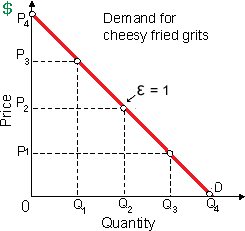
Demand for product is most elastic at price

From these points in this figure, demand for cheesy fried grits is largely elastic at a price of: (w) P1 and quantity of Q3. (x) P2 and quantity of Q2. (y) P3 and quantity of Q1. (z) P4 and quantity of 0.
1937_Price Elasticity of Demand5.png

Can someone explain/help me with best solution about problem of Economics...

   Related Questions in Microeconomics

  • Q : Consumer behaviour Graphical

    Graphical representation of relationship between MPC and multiplier?

  • Q : Unitarily elastic demand by fixing all

    A monopolist who does not price discriminate, that is: (w) cannot maximize profit by producing where demand is unitarily elastic. (x) will maximize profit where demand is unitarily elastic when all costs are fixed. (y) will maximize profit where deman

  • Q : Strategic barriers to entry Extensive

    Extensive national advertising can be a form of: (1) natural barrier. (2) strategic barrier. (3) regulatory barrier. (4) price discrimination. (5) moral hazard. Can anybody suggest me the proper explanation for given problem regard

  • Q : Potential advantage offer by Oligopolies

    Oligopolies offer a potential advantage to society since them: (w) may be capable to amass the huge resources required for modern research and growth. (x) tend to be more socially responsible than small firms. (y) typically maximize long run quite tha

  • Q : Problem on money diagram Help me to go

    Help me to go through this problem. Refer to the given market for money diagrams. If the interest rate was at 8 percent, people would: A) sell bonds, which would cause bond prices to fall and the interest rate to fall. B) buy bonds, which would cause bond prices to ri

  • Q : Market interest rates for different

    Market interest rates for different financial assets are positively associated to the: (w) expected rate of inflation. (x) liquidity of the assets. (y) efficiency of financial intermediation. (z) preferences of people about consuming in the future ins

  • Q : Wage Rate and Exploitation problem

    Assume that a firm possessesing both monopsony power as the employer and market power in its output market, however that can neither wage neither discriminate nor price discriminate. In equilibrium, in its labor market for workers, of the given variables the lowest va

  • Q : Rate of return by perpetuity price A

    A perpetuity currently priced at $5000 which will pay $200 annually all times generates a rate of return of: (w) 4%. (x) 4.8%. (y) 5%. (z) 3.5%. Hey friends please give your opinion for the problem

  • Q : Annual Percentage Rate and Annual

    Interest stated at an annual percentage rate that stands for APR is the rate of interest without consideration of compounding throughout that year. Yearly or annual percentage yield [APY] refers to interest which is compounded continuously. When a ban

  • Q : Labor Unions and Inflation Even

    Even although less than 12 percent of labor in the U.S. is unionized, numerous argue that unions are the primary cause of inflation as union wage hikes: (i) Cause unemployment that is inflationary. (ii) Frequently serve as the goals in recognizing non-union wage. (iii