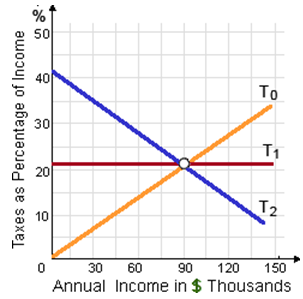
Define progressive in taxes as percentage of income
Line T0 depicts a tax system which is: (1) progressive. (2) recessive. (3) proportional. (4) biased. (5) regressive. Hey friends please give your opinion for the problem of Economic that is given above.
Line T0 depicts a tax system which is: (1) progressive. (2) recessive. (3) proportional. (4) biased. (5) regressive.
Hey friends please give your opinion for the problem of Economic that is given above.
Can someone specify correct answer of the given query of demonstrated figure in below that curve J is that cranberry of: (w) industry’s supply curve. (x) firm’s demand curve. (y) firm’s average variable cost curve. (z) firm’s short-run supply c
When market demands for agricultural products are relatively price inelastic and relatively income inelastic both, in that case as per capita income raises, the average income of farmers will: (w) increase while supplies of agricultur
During the long run, the labor supply curve facing a main industry: (w) will always be positively associated to the wage rate. (x) will slope upward only when individual labor supply curves slope upward. (y) can be backward bending at very high wage r
Society as entire benefits most when the distribution and production of penicillin corresponds to: (a) point a. (b) point b. (c) point f. (d) point d. (e) point g. Q : Good illustration of oligopoly The The tobacco industry within the United States is a good illustration of: (1) monopoly. (2) pure competition. (3) oligopoly. (4) corporate responsibility. (5) duopoly. I need a good answer on the topic of Economics
The tobacco industry within the United States is a good illustration of: (1) monopoly. (2) pure competition. (3) oligopoly. (4) corporate responsibility. (5) duopoly. I need a good answer on the topic of Economics
I have a problem in economics on highly competitive market in long run. Please help me in the following question. When markets are highly competitive, in long run then: (1) Economic profits will be positive. (2) Economic gains will be negative. (3) Economic profits wi
For a purely competitive industry in the long run: (i) several firms exit therefore others may earn more than normal profits. (ii) established firms reap higher profits than newer firms. (iii) all resources are fixed for the industry as an entire. (iv
When all goods are produced in highly competitive markets as well as there are no externalities, goods tend to be manufactured: (i) relatively inefficiently. (ii) along with the most efficient technology at the lowest price. (iii) along with maximum p
In states that encompass ‘Right to Work’ laws, then collective bargaining agreements: (i) Can’t need all employees to join a union in a specified period after being hired. (ii) Generally state the number of employees a firm
The Latin phrase applies to the idea which all other effects on some dependent variable are to be supposed constant if examining the effect of changing a single independent variable is as: (1) Fiat justitia, ruat coelum. (2) Platea unum. (3) Unum paribus. (4) Ceteris
18,76,764
1949810 Asked
3,689
Active Tutors
1430822
Questions Answered
Start Excelling in your courses, Ask an Expert and get answers for your homework and assignments!!