--%>

Define Number of Interleavings

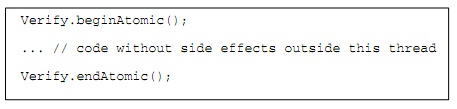
Number of Interleavings: Besides the raw number of threads, the state space is affected by the number of potential interleavings of these threads. While there exist automated techniques (partial-order reduction) to reduce these interleavings, most model checkers include some kind of interface to denote atomic sections (code which does not interfere with other threads). Previous versions of JPF supported two primitives: Verify.beginAtomic() and Verify.endAtomic(). They were used to mark a section of the code that would be executed atomically by the model checker so that no thread interleavings were allowed.
2229_interleavings.jpg

These calls are deprecated in the current version of JPF, which by default supports partial-order reduction instead. Use the Verify.beginAtomic and Verify.endAtomic primitives with care because a deadlock will occur when a thread becomes blocked inside of an atomic section.

   Related Questions in Programming Languages

  • Q : What is Universal Character Set or UTF

    UTF: Universal Character Set (abbreviated as UCS) Transformation Format. The format for symbolizing multibyte characters which is compatible with programs and file systems which were only made to handle single byte characters.

  • Q : What is Unique Identifier What is

    What is Unique Identifier and how do I determine one?

  • Q : What are Literals What are Literals and

    What are Literals and also state their respective types?

  • Q : Define the term Binary Binary : This is

    Binary: This is the number representation in base 2. In base 2, only digits 0 and 1 are utilized. Digit positions symbolize successive powers of 2.

  • Q : Explain Static variable Static variable

    Static variable: It is a static variable defined within a class body. Such a variable fits in to the class as a whole, and is, thus, shared by all objects of the class. The class variable may be employed to define the default value of an instance vari

  • Q : Explain Inheritance hierarchy

    Inheritance hierarchy: The relationship among super-classes and sub-classes is termed as an inheritance hierarchy. The single inheritance of classes means that each and every class has simply a single `parent' class and that Object class is the eventu

  • Q : Explain Call-by-value Call-by-value:

    Call-by-value: The semantics of passing an argument to a method in which a copy of actual argument value is taken and positioned in a separate memory location, symbolized by the corresponding formal argument. As an outcome, assignment to the formal ar

  • Q : Explain Method overloading Method

    Method overloading: Two or more techniques with similar name stated within a class are said to be overloaded. This exerts to both constructors and other methods. The overloading applies via a class hierarchy, thus a sub class may overload a method sta

  • Q : What is Native Mode Native Mode :

    Native Mode: Whenever all the domain controllers in a specified domain are executing Windows 2000 Server. This mode permits organizations to take benefit of new Active Directory features like Universal groups, nested group membership, and the inter-do

  • Q : Define Function Function : The name

    Function: The name given to assembly of statements which does some particular task and might return a value. Function can be invoked (or called) any number of time and anywhere in the program.