--%>

Define Break Even point

Define Break Even point? Elucidate with the help of saving function.

Answer: Breakeven point is a point where consumption equals to income and saving is equivalent to zero.
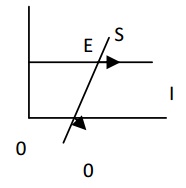
110_break even.jpg

At point E saving is equivalent to zero; therefore point E is termed as Break Even point. To the left of point saving is negative, and to the right of E saving is positive.

   Related Questions in Macroeconomics

  • Q : Sources of demand for foreign currency

    State main sources of demand for foreign currency? Answer: The four main sources of demand for foreign currency are as follows: A) To buy services and goods from other countries. B) To send a gift abroad.

  • Q : Definition of equilibrium price

    Definition of equilibrium price: It is the price which balances quantity demanded and quantity supplied. The equilibrium price is frequently termed as the "market-clearing" price since both buyers and sellers are p

  • Q : Problem on equivalent Consumer Surplus

    Tom reimburses $5.00 for a ticket to see a present hit movie. If Tom was willing to reimburse up to $7.00 for that ticket, his consumer surplus equals: (1) $5.00 (2) $2.00 (3) $7.00 (4) Tom does not receive any consumer surplus as he purchased the ticket.

  • Q : Assignment for help Help me with this

    Help me with this assignment! Just 25 questions! Thank you so much!

  • Q : Evaluation of net present value Explain

    Explain evaluation of net present value (NPV) and internal rate of return (IRR) in brief?

  • Q : Consumption curve Illustrate a point on

    Illustrate a point on consumption curve at which APC = 1. Answer: APC = C/Y = 1 is possible when C = Y, that is, Consumption is

  • Q : How commercial bank make money How does

    How does a commercial bank make money? Answer: Commercial banks are capable to make credit that is many times greater than deposits received by banks. Money creatio

  • Q : Backward shifting of incidence tax When

    When firms bear the legal incidence of a tax, this is backward shifted while: (1) firms burden consumers by raising their prices. (2) the tax burden is borne by workers in the form of lower wages. (3) resource suppliers seek higher factor payments to

  • Q : Demand according to range of adjustments

    As longer time periods are taken and a bigger range of adjustments (or substitutions) become obtainable, then demand curves tend to become: (1) flatter, as supply curves become steeper. (2) Steeper as supply curves become flatter. (3) Flatter, and therefore do supply

  • Q : Type of market when people cannot buy

    Whenever people can’t purchase all of a good they are willing and capable to pay for at present market price, there is surely a market: (1) Price ceiling. (2) Price floor. (3) Shortage. (4) Anomaly.  (5) Surplus. Please