--%>

Decreased market demand for generic 2×4s

Decreased market demand for generic 2×4s as in illustrated graph would result within a(n) ___________ into the price of 2×4s as well as a(n) ___________ in this lumber mill’s profit-maximizing output. (w) increase; decrease. (x) increase; increase. (y) decrease; decrease. (z) decrease; increase.
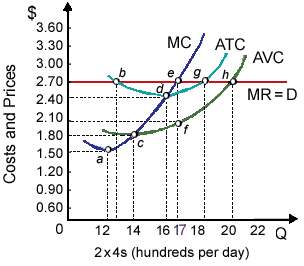
1571_Profit Maximization.png

Please choose the right answer from above...I want your suggestion for the same.

   Related Questions in Microeconomics

  • Q : Capital Goods In the above diagram, the

    In the above diagram, the elimination of discrimination is best represented by

  • Q : Barriers prevent entry in long run

    Within the long run, a monopoly cannot continually produce economic profit unless: (w) economies of scale are important. (x) corporate taxes are lowered. (y) barriers to entry are significant. (z) the monopolist maximizes profit.

  • Q : Barriers to entry for new firms in

    Barriers to entry, that is:  (w) make this complicated or impossible for new firms to profitably enter an industry. (x) uniformly violate U.S. antitrust statutes. (y) are essentially technological instead of economic. (z) stimulate aggressive com

  • Q : Supply curve for perishable goods The

    The supply curve for perishable goods which, once produced, can’t be stored in inventory is generally functioned as perfectly price inelastic into the: (i) short-run. (ii) intermediate period. (iii) long-run. (iv) market period. (v) fiscal year

  • Q : Main cause of oligopolies A main cause

    A main cause of oligopolies is: (w) mergers. (x) economies of scale. (y) barriers to entry. (z) all of the above. Please choose the right answer from above...I want your suggestion for the same.

  • Q : Principal-Agent Problems-Institutions

    According to the John Kenneth Galbraith, the modern corporate planning: (i) Aims at decreasing risks to the managers of main firms. (ii) Stresses the maximization of gains. (iii) Is much concerned with the social goals. (iv) Maximizes the social welfare.

  • Q : Propensity to consume Propensity to

    Propensity to consume: This exhibits the level of consumption at various levels of income in the economy.

  • Q : Total fixed cost in competitive firm

    This competitive firm's fixed cost or TFC in demonstrated can be computed as area as: (i) 0P3fq4. (ii) P2P1de. (iii) P3P2ef. (iv) 0P2eq4. (v) aced.

    Q : Determine competitive price of purely

    In this demonstrated figure purely competitive lumber mill’s generic 2×4s now sell for: (1) $3.60 each. (2) $3.00 each. (3) $2.70 each. (4) $2.40 each. (5) $2.10 each.

    Q : Gini Coefficient in Loren Curve A Gini

    A Gini coefficient for this demonstrated figure can be computed as: (w) area A minus area B. (x) area A × area B.  (y) area C minus [area A + area B]. (z) [area A] / [area A + area B].

    Discover Q & A

    Leading Solution Library
    Avail More Than 1416634 Solved problems, classrooms assignments, textbook's solutions, for quick Downloads
    No hassle, Instant Access
    Start Discovering

    18,76,764

    1932284
    Asked

    3,689

    Active Tutors

    1416634

    Questions
    Answered

    Start Excelling in your courses, Ask an Expert and get answers for your homework and assignments!!

    Submit Assignment

    ©TutorsGlobe All rights reserved 2022-2023.