--%>

Costs and revenue verses Quality analysis

Refer to figure as in above. What occurs when the firm produces more than Q4 units: w) Its profit raises. x) this makes a loss. y) Its total revenue is increasing quicker than its whole cost. z) this could make a profit or a loss depending upon what occurs to demand.
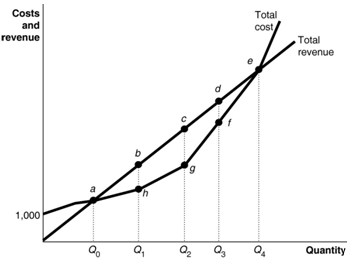
1967_Maximizes profits of firm in a perfectly competitive market.png

How can I solve my economics problem? Please suggest me the correct answer.

   Related Questions in Managerial Economics

  • Q : Problem on Occupational Crowding After

    After vacationing hundreds of restaurants, then a restaurant critic has concluded which in almost all the workers who clear tables and also wash dishes appear to be illegal aliens by Mexico. The critic has observed a phenomenon termed as: (1) marginalized labor. (2) t

  • Q : Demad elacticty demand function is: QY

    demand function is: QY = -8,000 - 5,000PY + 192A + 120I + 2,000PX (6,000) (1,000) (120) (80) (800) R2 = 91% Here QY is quantity (measured in units) of Product Y demanded in the current period, A is hundreds of dollars of advertising ($00), I is thousands of dollars of disposable income per ca

  • Q : Advantages and disadvantages of Trend

    What are the advantages and disadvantages of trend projection method?

  • Q : Explain the term Production function

    Explain the term Production function.

  • Q : Making a decision regarding resource

    To make a decision regarding resource hire, the firm should take as: (w) the price of the resource. (x) the productivity (Marginal Price) of the resource. (y) output prices. (z) All of the above. How can I solve my Economic

  • Q : Occupational Crowding in Wage

    Disadvantaged groups have historically been pressured toward low wage jobs in a procedure termed as: (1) occupational crowding. (2) labor staggering. (3) systemic discrimination. (4) reverse favoritism. (5) nepotism.

    Q : Illustrates the different kinds of

    Illustrates the different kinds of Demand?

  • Q : Costs of investing within human capital

    The costs of investing within human capital are probably to be borne by the employee when human capital a worker obtains “on the job” is: (1) general. (2) marginal. (3) precise. (4) generic. (5) specific.

    Q : What is Constant Returns to scale What

    What is Constant Returns to scale?

  • Q : Objectives ans uses Help to achive the

    Help to achive the other objectives of the firm like industry leadership,expansion implementation of policies